The short answer
High Island is a small community on the upper Texas coast, just off Highway 87, that sits on top of a salt dome. Birds Houston’s history page explains it: a thick layer of ancient salt lies about 30,000 feet beneath south-east Texas, and in places, as here, a column of it was squeezed upward, forming a salt cylinder some six miles tall and about a mile across. The rising salt shattered and tipped the layers above it, and oil and gas pooled around its edges; exploration began in 1901, commercial production in 1922, and production continues. Today the rise stands 32 feet above the surrounding marshes, with soil that suits trees and shrubs. Birds Houston owns four sanctuaries in its woods, Boy Scout Woods, Smith Oaks, Eubanks Woods and S.E. Gast Red Bay, all open every day of the year from dawn to dusk, and manages a fifth, Hooks Woods, for the Texas Ornithological Society. Nearly 400 bird species have been documented on its properties.
From Tally’s diary
Flat marsh in all directions, then a low hill of old oaks with a pump nodding beside it. Hot, wet air. I sat on a wooden bench by a small pond with a row of strangers. Then a dark line of weather came in off the sea, and the trees filled with red and orange and yellow birds, as if somebody had shaken out a paint box. Nobody spoke.
Why it's worth knowing
Landfall after the Gulf. Birds Houston’s visitor page puts peak spring migration from mid-March to mid-May and says numbers are highest during a fallout, which sometimes comes with a fast-moving cold front. Its blog for visitors explains why: birds ride south winds north across the Gulf, and if they meet a cold front or a storm system from the north they are forced down as soon as they reach the coast. The same post quotes Wyatt Egelhoff, a Birds Houston sanctuary manager, giving 20 April to 5 May as the usual peak for the greatest diversity and numbers, and warns that strong south winds let birds fly on inland, so that slow days are common. Unlike many hotspots that are best at sunrise, the post adds, High Island often sees its best arrivals in the afternoon or evening, as birds finish their crossing. In autumn, late September to mid-October usually gives the best results.
Birders since the 1940s. Birds Houston writes that the woods have been a stopping place for migrating birds for thousands of years, but have drawn birdwatchers only since the 1940s, when birders from nearby Beaumont began visiting each spring. The Houston Audubon Society bought the first four acres of oak and hackberry woods, the Louis B. Smith Bird Sanctuary, known as Boy Scout Woods; its history page dates the purchase to 1981 and the sanctuary’s own page to 1982. In 1992 the society, the Nature Conservancies of Texas and Louisiana, the US Fish and Wildlife Service, the National Fish and Wildlife Foundation, Texas Parks and Wildlife, Amoco and Phillips Petroleum formed the High Island Initiative, which led to the Gulf Coast Bird Observatory and to the sanctuaries’ expansion, much of it on land Amoco donated.
The field notes
Bleachers by Purkey’s Pond
Boy Scout Woods, 60 acres of hackberry and oak motte, coastal prairie and wetland a mile from the Gulf, is the sanctuary where, Birds Houston says, thousands of birdwatchers from all over the world sit each spring in the grandstands overlooking Purkey’s Pond, waiting for migrants to come down to drink and bathe. Volunteers host the sanctuary daily from mid-March to early May, and its boardwalks let wheelchair users bird the woods. Prothonotary Pond, once dominated by invasive Chinese tallow trees, has been replanted with native bald cypress. Flash photography is allowed only inside the photo blind.
The rookery in Claybottom Pond
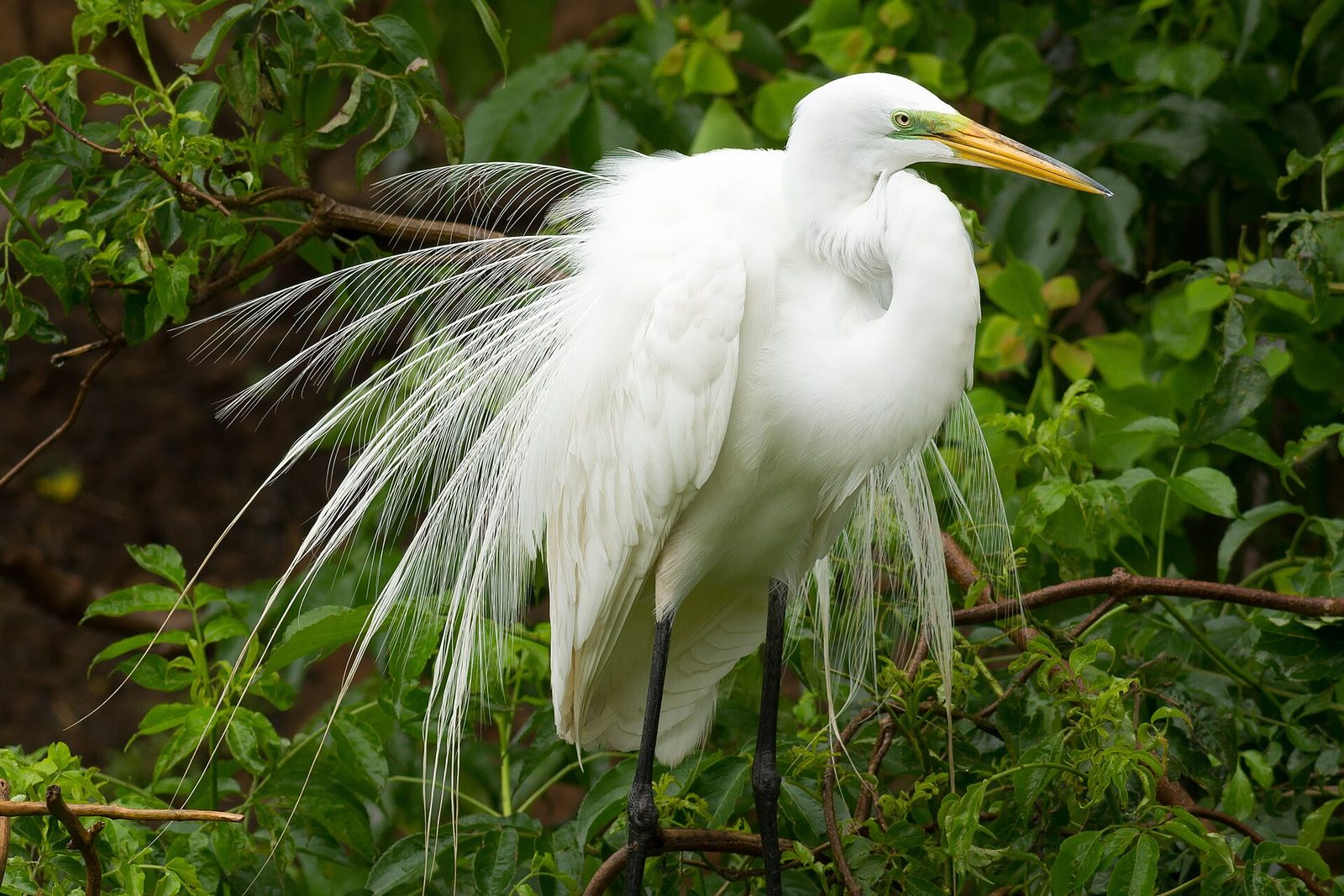
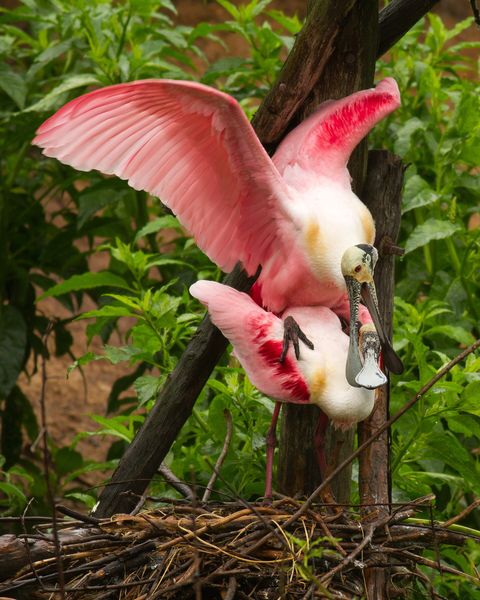
Smith Oaks, 177 acres of oak mottes, ponds, wetlands and coastal prairie, holds the rookery: an island in the middle of Claybottom Pond that Birds Houston says has become a favoured roosting and nesting place for thousands of waterbirds. Its blog names roseate spoonbills, egrets, herons, anhingas and cormorants nesting in full view, with observation platforms around the pond and the Kathrine G. McGovern Canopy Walkway looking down into the treetops. The pond itself was dug to hold water for the town and for a sulfur plant to the east; the dock on its east side once held the pumps.
Oil under the oaks
Smith Oaks is named for George and Charlotte Smith, who acquired the land in 1879 and farmed it with cattle, fruit, sugar cane, cotton and tobacco. Much of the sanctuary was later oil-field land: Birds Houston says a brick building from the 1920s housed pumps that sent oil from the field into pipelines, and the field to its east held large storage tanks until 1993, since erased by prairie restoration. Most oil production on the dome has been along its west, north and east sides.
A resort the storm ended
The dome’s mineral springs once made High Island a resort, Birds Houston writes: the railroad ran excursions to the springs and the beach, and in 1895 W.T. Cade built the Seaview, a large hotel facing the Gulf, with a ballroom and a mule-drawn rail car to the beach. The 1900 hurricane ended the resort years, though the hotel survived it; it was abandoned during the Second World War and burned in 1947. Shell middens, black pottery and arrow points from as far back as 1200 AD on the Bolivar Peninsula and around Galveston Bay show that Native Americans used the area; no archaeological site on High Island itself has been excavated.

April 2015Roseate spoonbills at Smith Oaks Sanctuary.
Photograph: Frank Schulenburg, CC BY-SA 4.0

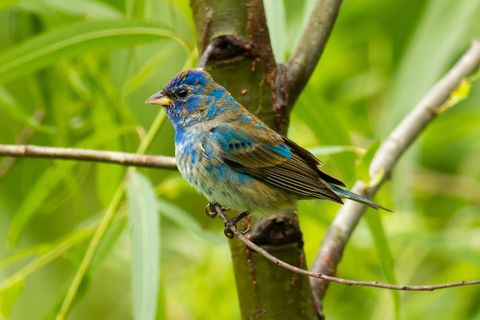
April 2015A male indigo bunting, part blue and part brown, at Smith Oaks Sanctuary in spring.
Photograph: Frank Schulenburg, CC BY-SA 4.0

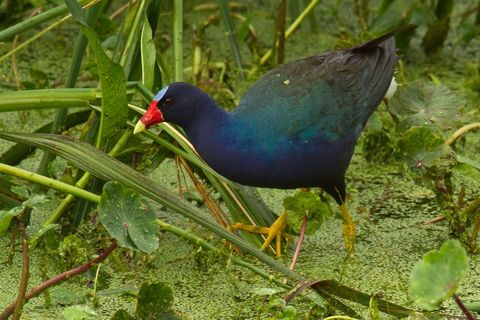
April 2015A purple gallinule in the duckweed at High Island.
Photograph: Frank Schulenburg, CC BY-SA 4.0, cropped
- Watch the weather, not the calendar. When a storm comes in off the sea, drop everything and go and sit by the water.
- The houses between the woods belong to people who live here. Point your binoculars at trees, not windows.
- Give the front of the platform to somebody else after a while. There will be another bird.
- List each colour that lands. (Gave up at the third shade of orange and wrote ‘paint box’ instead, which I am counting as one item.)
- Stay into the afternoon. The tired ones arrive late, and so, I found, do I.
A relic from High Island

Relic, entry 312Deepest well: 1882, 32 feetWaters reported: 21
George Smith’s mineral water. In the late nineteenth century George Smith, who farmed the land that is now the Smith Oaks Bird Sanctuary, dug several wells on the High Island salt dome and reported 21 “distinct” waters; his deepest, dug in 1882, was 32 feet deep and also produced gas, which he treated as a nuisance because there was no market for it. He trademarked and bottled “High Island Mineral Springs Water” and sold it along the Texas coast, claiming, Birds Houston records, that it would cure kidney and liver trouble, asthma and hay fever, “restore hair on bald heads” and clear pimples. The ruins of one of his wells can still be seen in the woods across from the map shelter at the Winnie Street entrance.
Tally, in the marginA water said to cure everything, bald heads included, bottled on a hill so low you could walk over it without noticing. I read the old claims twice before it dawned on me what they had left out: the birds, which were the one cure the hill was actually offering.
Getting there
- 1
By road or by ferry
Two roads lead there: I-10 east from Houston to the exit at Winnie, then south on Highway 124; or the free Galveston–Bolivar ferry and then up the coast on Highway 87.
- 2
The sanctuary addresses
Boy Scout Woods is at 2088 5th Street, with visitor parking at 5th Street and Dunman; Smith Oaks is at 2205 Old Mexico Road, with a Winnie Street entrance open all year.
- ✓
| J | F | M | A | M | J | J | A | S | O | N | D |
|---|---|---|---|---|---|---|---|---|---|---|---|
| March: best time | April: best time | May: best time | September: also a good time | October: also a good time |
- From mid-March to mid-May
- Late September to mid-October
How to get there. Birds Houston names no airport, and we name none.
When to go. Spring migration runs from mid-March to mid-May, with the usual peak from 20 April to 5 May; watch the weather rather than the calendar, because a front from the north is what brings the birds down. In autumn, late September to mid-October is best. The two Birds Houston pages give different dates for the Old Mexico Road gate at Smith Oaks: the visitor page says it opens from dawn to dusk from 1 March to 15 May and on autumn weekends from 15 September to 15 October, the Smith Oaks page says from 15 February to 15 June and on the same autumn weekends. The Winnie Street entrance is open all year.
What to arrange ahead. The sanctuaries charge admission: a day pass, or an annual patch that admits one person to all five High Island sanctuaries for the year; Birds Houston membership does not include admission. Kiosks are staffed only during spring migration, and at other times visitors pay by cash or cheque in red honour boxes. There is no overnight parking or camping on Birds Houston land; Birds Houston points to beach camping on the nearby Bolivar Peninsula, which needs a Galveston County parking sticker.
Access. Birds Houston asks visitors to spend no more than 20 minutes at the front of the observation platforms, to move tripods off a platform when not shooting, and to leave chairs and equipment carts at home (strollers, wheelchairs and walkers are fine). Birds can turn up anywhere on High Island, including in residents’ yards: do not go into them, and take care where binoculars point.
Safety. High Island is on a hurricane coast, and the season runs from June to November.
For birders
- Recorded
- Birds Houston says nearly 400 species have been documented on its High Island properties, including several species recorded there for the first time in the United States.Source: Birds Houston (High Island visitor information) · read
- Best months
- Mar–May — Birds Houston puts peak spring migration from mid-March to mid-May, and says numbers are highest during a fallout, which sometimes comes with a fast-moving cold front.Source: Birds Houston (High Island visitor information) · read
- Where the source points
- Birds Houston says the rookery in the middle of Claybottom Pond at Smith Oaks is a roosting and nesting place for thousands of waterbirds.Source: Birds Houston (Smith Oaks) · read
- Official list
- High Island Bird ChecklistRead
- Visitor rule
- Birds Houston asks visitors to spend no more than 20 minutes at the front of the observation platforms, and allows flash photography only in the Boy Scout Woods photo blind.Source: Birds Houston (High Island visitor information) · read
Bird calendar
Seasons as published by the park, refuge or specialist body named in each row, with the date we read it.
-
Songbirds and other migrants stop over: March to May; peak April.
Source: Houston Audubon (Spring Migration) · read
-
Herons, egrets and spoonbills nest at the Smith Oaks rookery: March to June.
Source: Houston Audubon (Smith Oaks Rookery) · read
-
Migrant landbirds stop over during spring passage: March to May; peak April.
Source: Houston Audubon · read
Mark this place
The passport stamp for this place.
Common questions
Why is High Island good for birdwatching in spring?
High Island, on the upper Texas coast, is a salt dome whose oak woods rise 32 feet above the marshes, and Birds Houston calls it a critical place for migrating songbirds to land after crossing the Gulf of Mexico. Nearly 400 bird species have been documented on Birds Houston’s sanctuaries there.
When is the best time to visit High Island for migration?
Birds Houston puts peak spring migration at High Island, Texas, from mid-March to mid-May, and a sanctuary manager gives 20 April to 5 May as the usual peak for numbers and variety. Late September to mid-October is best in autumn. A cold front from the north matters more than the date.
What is a fallout at High Island?
A fallout at High Island, Texas, is a day when migrating songbirds flying north over the Gulf of Mexico on south winds meet a cold front or storms and come down at the coast in large numbers. Birds Houston says numbers are highest then, with warblers, tanagers, orioles and grosbeaks filling the oak woods.
What is the rookery at Smith Oaks?
The rookery at Smith Oaks Bird Sanctuary in High Island, Texas, is an island in the middle of Claybottom Pond where, Birds Houston says, thousands of waterbirds roost and nest. Its blog names roseate spoonbills, egrets, herons, anhingas and cormorants, seen from platforms around the pond.
Is High Island in Texas an island?
No. High Island is a community on the mainland of the upper Texas coast, built on a salt dome that rises 32 feet above the surrounding marshes. Birds Houston describes the wooded rise as an island of habitat for migrating birds, with soil that suits trees and shrubs in an otherwise flat coastal landscape.
How do you get to High Island from Houston?
Birds Houston’s directions to High Island, Texas, are I-10 east from Houston to the exit at Winnie, then south on Highway 124. The alternative is the free Galveston–Bolivar ferry, then Highway 87 up the coast. The sanctuaries are open every day of the year from dawn to dusk.
How many bird species have been seen at High Island?
Birds Houston says nearly 400 bird species have been documented on its High Island sanctuaries in Texas, including several species never before seen in the United States. It publishes a High Island bird checklist and points visitors to eBird, where Boy Scout Woods and Smith Oaks are listed as hotspots.
Photographs on this page
Tap a photograph to see it full size.
Photograph: Frank Schulenburg, CC BY-SA 4.0, cropped
Photograph: Frank Schulenburg, CC BY-SA 4.0
Photograph: Frank Schulenburg, CC BY-SA 4.0
Photograph: Frank Schulenburg, CC BY-SA 4.0, cropped




