The short answer
Hawk Mountain Sanctuary is a raptor sanctuary on the Kittatinny Ridge in Pennsylvania, owned and run by the Hawk Mountain Sanctuary Association, a private, member-supported non-profit; it says plainly that it is not a state or national park. It protects about 2,600 acres, has more than 9,000 members and more than 60,000 visitors a year, and keeps more than 8 miles of trails. Two lookouts face the migration. South Lookout is 175 yards from the entrance gate on a groomed path that motorised wheelchairs can use, and an accessible alternative, the Silhouette Trail, is 900 feet long with a grade no steeper than 8.3 per cent. North Lookout is reached by the Lookout Trail, with a vertical rise of 300 feet, and is a pile of large boulders that takes some rock scrambling to cross. Migrating raptors can be seen from mid-August to mid-December in autumn and from April to mid-May in spring, the sanctuary says.
From Tally’s diary
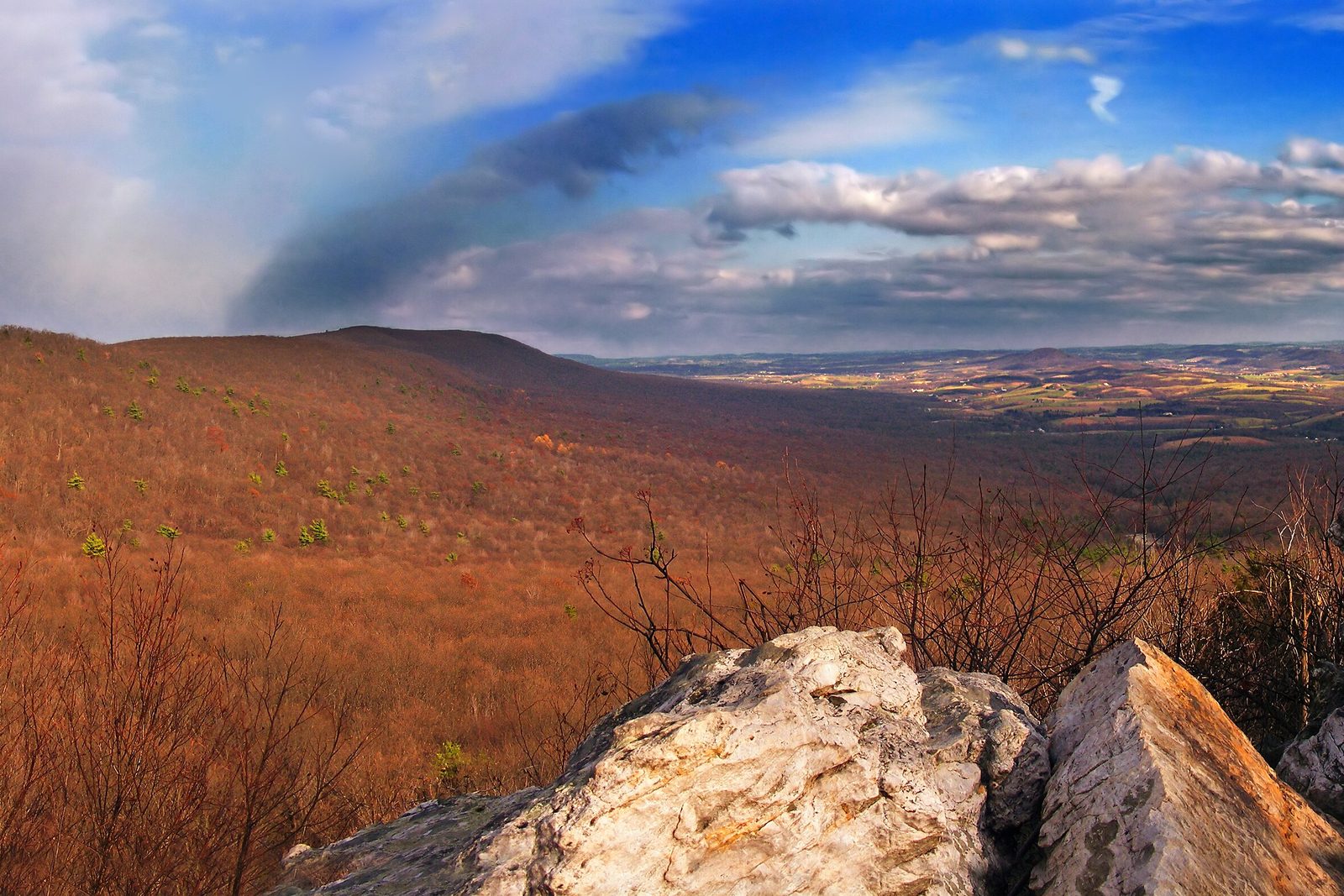
Climbed through rust and gold woods to grey boulders on top of a long, straight ridge, with a patchwork of farms and red barns below. A cold wind at my back. People sat on the rocks in hats, calling out directions in clock hours, and great brown birds came sliding along the ridge at the height of my nose. I bowed to one. It did not notice.
Why it's worth knowing
A refuge that began as a shooting ground. The sanctuary tells its own history this way. In 1929 the Pennsylvania Game Commission put a five-dollar bounty on the goshawk. Two years later Richard Pough, an amateur ornithologist in Philadelphia, heard of the place locals called Hawk Mountain, found gunners shooting hundreds of passing hawks for sport, and went back to photograph the carcasses on the forest floor. His photographs reached Rosalie Edge, a New York conservation activist, who came in 1934, leased 1,400 acres and installed a warden, Maurice Broun, with his wife and partner in bird conservation, Irma Broun. The shooting stopped immediately, and the next year she opened the sanctuary to the public. She later bought the land and deeded it to the Hawk Mountain Sanctuary Association, incorporated as a non-profit in 1938. Broun began the count in 1934, and the sanctuary’s published records run from that season to this one.
A count anyone can watch. Over the four months from 15 August to 15 December the autumn count averages about 18,000 raptors, the sanctuary says, with usual one-day peaks of more than 3,000 birds in September during the broad-winged hawk migration. Flights are best one to two days after a cold front, on north-west winds that press the birds against the ridge and its updrafts, and the greatest variety of species comes in late October. Most migrants pass between 8 a.m. and 5 p.m.; on calm, sunny days the birds ride thermals higher and farther from the lookouts in the middle of the day, so mid-to-late morning and mid-to-late afternoon are often better. Spring is quieter: the 2026 spring watch closed on 15 May with 658 raptors, 30 per cent below the ten-year average.
The field notes
September’s broad-wings
The broad-winged hawk carries the autumn count, pouring past in September on days of more than 3,000 birds. Behind it comes a long, varied parade: sharp-shinned hawks above all, then red-tailed hawks, bald eagles, Cooper’s hawks, turkey vultures, American kestrels, ospreys, merlins, northern harriers and peregrine falcons, among others.
Eagles late in the season
The sanctuary says the best variety of raptors passes in late October, and the count runs on to 15 December. Late in the season the golden eagles come through. Strong north-west winds bring migrants close to watchers at North Lookout, the sanctuary explains, because the birds use the updrafts the deflected wind creates to save energy; on steady south or south-west winds both lookouts can have many sightings as birds follow the ridge’s southern slope.
Two lookouts and a rough way down
An observer-interpreter is stationed at South Lookout every day from September to early November. The sanctuary’s trails are rocky and ungraded, except the walk to South Lookout. The Skyline Trail follows the spine of the Kittatinny east over North Lookout and East Rocks, a good place to watch migration, to meet the Appalachian Trail 2.5 miles away; it includes four-point rock scrambling and, just off North Lookout, a 30-foot vertical descent, and the sanctuary recommends it only for experienced hikers. The trails are open in winter but are not maintained for it.
From one ridge to others
Hawk Mountain trains conservationists from abroad, and the sanctuary says its graduates have helped set up places with a similar origin story elsewhere, trading damaging raptor hunting for eco-tourism, naming Batumi in the Republic of Georgia.

November 2008The valley below Hawk Mountain through bare oaks.
Photograph: Nicholas A. Tonelli, Flickr - Nicholas T - Basin, CC BY 2.0, cropped

May 2026The boulders of North Lookout, looking east along the ridge.
Photograph: Dough4872, CC BY-SA 4.0, cropped

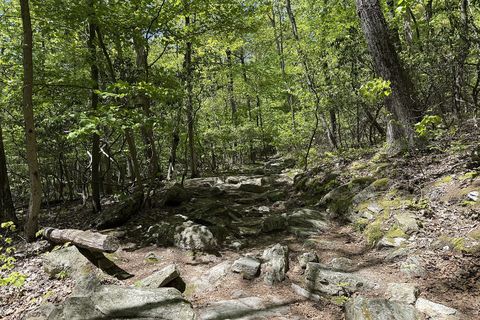
May 2026The Lookout Trail climbing through the woods.
Photograph: Dough4872, CC BY-SA 4.0, cropped
- Go the day after the weather turns cold, when the wind comes over the ridge from behind you, and dress as if you will sit still for hours, because you will.
- Wear proper shoes. The way to the top is a scramble over boulders, and the boulders do not care what you meant.
- Keep your voice low on the rocks. Somebody up there is counting, and every bird matters to the count.
- Count the birds yourself. (Abandoned at the first big swirl. The people with the clipboards do it properly, so I have handed them the job and added them to the list.)
- Sit with your back against a rock and look along the ridge, not up it. The birds come down it like traffic down a road.
A relic from Hawk Mountain

Relic, entry 311Trail drop: 600 feetLoop walk: three to four hours
The River of Rocks. Below South Lookout at Hawk Mountain Sanctuary lies the River of Rocks, which the sanctuary describes as an Ice-Age boulder field: a long stream of grey boulders lying in the valley between the ridges, with no water to be seen on it. The River of Rocks Trail, marked with red blazes, leaves the Lookout Trail just before South Lookout after 0.3 miles, drops 600 feet and loops around the boulder fields; the sanctuary warns that it is very rough and rocky, that unmarked paths cross it, and that the loop takes three to four hours.
Tally, in the marginA river made entirely of boulders, lying in the valley under the lookout. I watched it for some time before admitting it was not going to move, and some time after that before it occurred to me that it had already arrived.
Getting there
- 1
No public transport
No public transport reaches the sanctuary and there is no nearby bus company, and its staff cannot give visitors rides.
- 2
Enter at the trailhead
Visitors enter at the trailhead entrance across Hawk Mountain Road from the Visitor Center.
- 3
Back before dusk
The trails close at dusk; on them, voices stay low at the lookouts and nobody crosses the safety rails.
- ✓
| J | F | M | A | M | J | J | A | S | O | N | D |
|---|---|---|---|---|---|---|---|---|---|---|---|
| April: also a good time | May: also a good time | August: also a good time | September: best time | October: best time | November: also a good time | December: also a good time |
- September for broad-wings; late October for variety
- From mid-August to mid-December in autumn and from April to mid-May in spring
How to get there. The sanctuary’s pages name no airport, and we name none.
When to go. The autumn count runs from 15 August to 15 December, with September’s broad-winged hawk peak and the widest variety in late October; spring migration runs from April to mid-May. Go one or two days after a cold front, on a north-west wind, and stay into the afternoon. Late autumn and winter bring the deer-hunting season, when the sanctuary shuts all its trails on some days and leaves only the Lookout Trail open on others.
What to arrange ahead. The Visitor Center and trails are open daily from 9 a.m. to 5 p.m.; the sanctuary closes on Thanksgiving, Christmas Eve, Christmas Day and New Year’s Day, and at 1 p.m. on the day before Thanksgiving and on New Year’s Eve. Non-members pay a trail fee at the Visitor Center or buy a ticket online and bring a printed copy: 10 dollars for adults, 7 for seniors over 65, 5 for children aged 6 to 12, and free for children 5 and under and for members. Trail fees, the sanctuary says, fund its research, training, education and trail upkeep, and walkers who enter the trails without paying are trespassing.
Access. No pets are allowed on the trails, even on a leash; service animals are welcome. Firearms, smoking, radios, alcohol, hammocks, bicycles, drones, camping and fires are not allowed. There are no rubbish bins: carry everything out. Stay on the trails, keep voices low at the lookouts, never cross safety rails, and allow time to get back before the trails close at dusk.
Safety. The hazards are the ridge’s own: rocky, ungraded trails, a boulder scramble at North Lookout, and ice in winter, when the sanctuary advises cleats and poles. A self-service first-aid area is at the Visitor Center, and staff and volunteers on the trails carry basic kits.
For birders
- Designation
- Hawk Mountain Sanctuary, founded in 1934, calls itself the world's first refuge for birds of prey; it is a private non-profit, not a state or national park.Source: Hawk Mountain Sanctuary (about) · read
- Birds to look for
- The sanctuary says September's one-day peaks come with the broad-winged hawk migration, and the best variety of raptors passes in late October.Source: Hawk Mountain Sanctuary (Autumn Hawk Migration) · read
- Best months
- Aug–Dec — The sanctuary says hawks can be seen migrating past from mid-August to mid-December in autumn and from April to mid-May in spring.Source: Hawk Mountain Sanctuary (Autumn Hawk Migration) · read
- Visitor rule
- The sanctuary allows no pets on its trails, even on a leash, and no drones, radios or fires; visitors carry out all rubbish.Source: Hawk Mountain Sanctuary (rules and regulations) · read
- Numbers
- The sanctuary says its autumn count, 15 August to 15 December, averages about 18,000 raptors, with one-day peaks of more than 3,000 in September.Source: Hawk Mountain Sanctuary (Autumn Hawk Migration) · read
Bird calendar
Seasons as published by the park, refuge or specialist body named in each row, with the date we read it.
-
Broad-winged hawks pass south: September; peak September.
Source: Hawk Mountain Sanctuary (Visiting year round) · read
-
Hawks, eagles and falcons pass south: August to December.
Source: Hawk Mountain Sanctuary (Autumn Hawk Migration) · read
-
Golden eagles pass south: November; peak November.
Source: Hawk Mountain Sanctuary (Golden Eagle) · read
-
Raptors pass north: April to May; peak April.
Source: Hawk Mountain Sanctuary (Spring Hawk Migration) · read
Mark this place
The passport stamp for this place.
Common questions
When is the best time to see hawks at Hawk Mountain?
Hawk Mountain Sanctuary in Pennsylvania says raptors migrate past from mid-August to mid-December in autumn and from April to mid-May in spring. September brings the broad-winged hawk peak, with one-day counts of more than 3,000, and late October brings the widest variety, golden eagles included.
How many raptors pass Hawk Mountain each autumn?
The autumn count at Hawk Mountain Sanctuary, kept from 15 August to 15 December, averages about 18,000 raptors, the sanctuary says. Most of them are broad-winged hawks, which can pass at more than 3,000 in a single September day.
Why was Hawk Mountain Sanctuary founded?
Hawk Mountain Sanctuary was founded in 1934 to stop the shooting of migrating hawks on Pennsylvania’s Kittatinny Ridge. After Richard Pough photographed hawks killed there for sport, Rosalie Edge leased 1,400 acres, installed the warden Maurice Broun and ended the shooting; the sanctuary calls itself the world’s first refuge for birds of prey.
Is Hawk Mountain a state park?
No. Hawk Mountain Sanctuary in Pennsylvania is not part of any state or national park. It is owned and run by the Hawk Mountain Sanctuary Association, a private, member-supported non-profit incorporated in 1938, and its trail fees and membership dues fund its raptor research, training, education and trails.
How hard is the walk to North Lookout at Hawk Mountain?
The Lookout Trail to North Lookout at Hawk Mountain Sanctuary climbs 300 feet over rocky, ungraded ground, and the lookout itself is a field of large boulders that needs some scrambling. South Lookout, 175 yards from the entrance gate, is reached on a groomed path that wheelchairs can use.
Can I bring my dog to Hawk Mountain?
No. Hawk Mountain Sanctuary allows no pets on its trails, even on a leash; service animals for visitors with disabilities are permitted. The sanctuary points dog walkers to the Appalachian Trail, which crosses Hawk Mountain Road about 1.5 miles east of the Visitor Center.
What weather is best for watching hawks at Hawk Mountain?
Hawk Mountain Sanctuary says the best autumn flights come one to two days after a cold front passes through the north-eastern United States, when winds swing to the north-west. Strong north-west winds push migrating raptors close to North Lookout as they ride the updrafts along the Kittatinny Ridge.
Photographs on this page
Tap a photograph to see it full size.
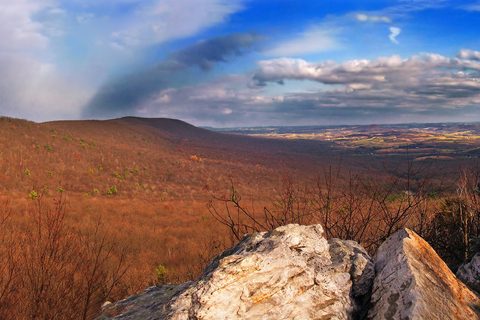
Photograph: Nicholas A. Tonelli, Flickr - Nicholas T - Far View, CC BY 2.0, cropped
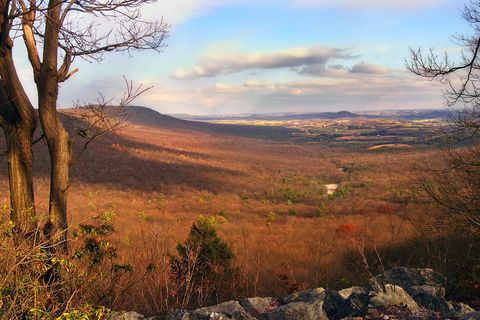
Photograph: Nicholas A. Tonelli, Flickr - Nicholas T - Basin, CC BY 2.0, cropped
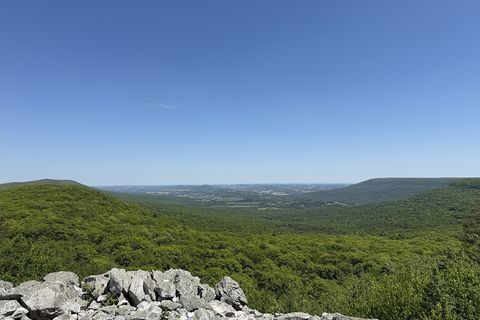
Photograph: Dough4872, CC BY-SA 4.0, cropped
Photograph: Dough4872, CC BY-SA 4.0, cropped




