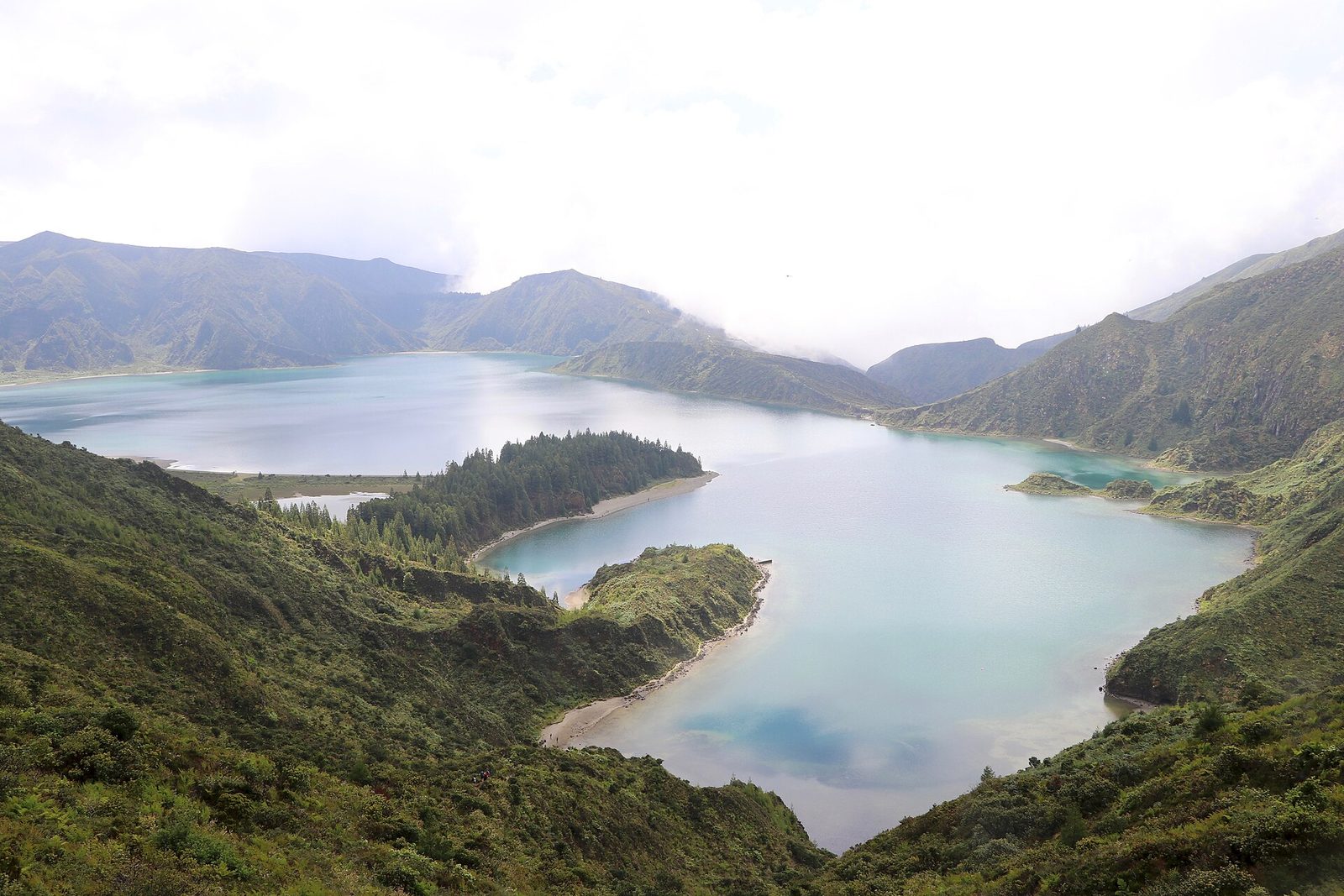
The short answer
São Miguel is the largest and most populous island of the Azores, the Portuguese archipelago in the North Atlantic, Wikipedia records; its infobox gives 744.55 square kilometres and 133,295 people in 2021, while the article’s opening gives 760 square kilometres and around 140,000 people. Its capital, Ponta Delgada, is the largest city of the archipelago. Settlers from mainland Portugal arrived in 1427, although the date of discovery is uncertain, somewhere between 1426 and 1437. The island is nicknamed the Green Island, Ilha Verde. Pineapples, tea and tobacco became its export crops after the Liberal Wars of the 1830s, and whale-watching boats now leave from Ponta Delgada and Vila Franca do Campo.
From Tally’s diary
Hedges of blue flowers along every lane, cows on fields so green they looked freshly painted, and cloud resting on the hilltops like a lodger who had paid in advance. In one valley the ground steamed, bubbled and smelled of eggs, and cooks were hauling big pots up out of holes in it. Lunch arrived from one of those, and tasted faintly of the valley.

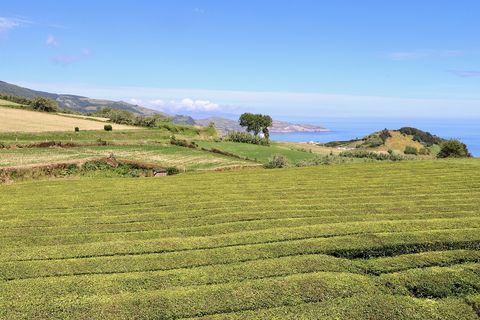
June 2018Tea rows running down to the Atlantic at Gorreana.
Photograph: Navin75, Gorreana tea estate, CC BY-SA 2.0
Why it's worth knowing
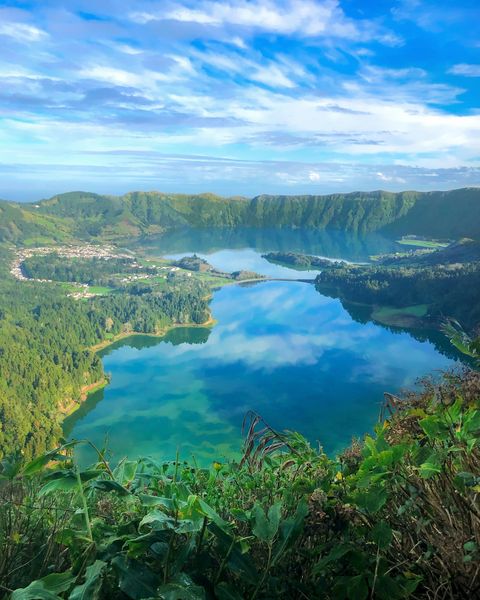
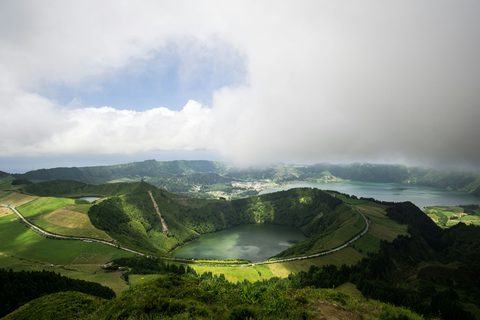
A lake told as two. At the west end of the island, the Sete Cidades massif holds a central caldera about 6 by 5 kilometres, Wikipedia records; its last eruption inside the caldera was around 500 AD. In the caldera lies the Lagoa das Sete Cidades, 4.35 square kilometres and 33 metres deep at most, the largest body of water in the region. It is one lake, but it is usually described as two, the Green Lake and the Blue Lake, joined by a narrow strait with a bridge across it; the article says each side reflects the light in a different colour. In the legend, a princess named Antília and a shepherd who played the flute were forbidden to marry, and the tears they wept together became the two lakes, one green for her eyes and one blue for his.

The green and blue lakes of Sete Cidades side by side, February 2023.
Photograph: Anna Jewels via Unsplash, Unsplash licence
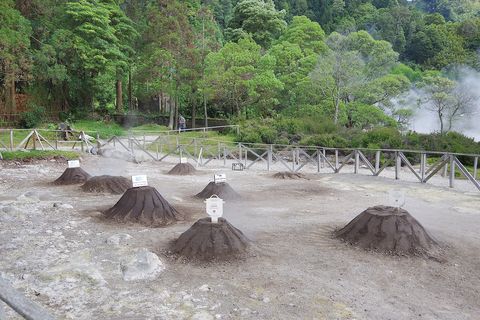
Lunch from the ground. Furnas, in the east of the island, lies in a volcanic caldera; its last eruption, from September to November 1630, killed 200 people, Wikipedia records, and the volcano is considered very active. The village has thirty springs of differing temperatures and chemistry, and fumaroles and mud pools steam on the northern shore of Lagoa das Furnas. Local people cook stews in the hot ground, most famously the beef stew called cozido das Furnas. On the south shore of the lake, 56 holes in the ground are kept for it, some for the public and some for the restaurants; each pot sits in its own hole for six to seven hours, at 64 to 96 °C, and the restaurants lift theirs out between 11 a.m. and 1 p.m.
Tea in Europe. The farmer José do Canto first imported tea to São Miguel in 1860, and in 1878 the island’s agricultural society brought two tea specialists from Macau, Lau-a-Pan and his interpreter Lau-a-Teng, to teach the trade, Wikipedia records. Ermelinda Gago da Câmara founded the Gorreana plantation in 1883; Wikipedia calls it the oldest surviving tea plantation in Europe and one of only two still operating in the Azores.
The field notes
The volcanoes are watched
The Azores’ centre for volcanic and seismic monitoring, CIVISA, publishes the alert level of each volcanic system on a scale whose lowest rung reads “Sistema vulcânico em fase de repouso – Atividade normal”, a system at rest, with normal activity. It also posts a notice whenever a small earthquake is felt on the island.

May 2019Mounds over cozido pots in the hot ground at Furnas.
Photograph: Jan Helebrant, CC0

A crater lake ringed by pastures above Sete Cidades, 2018.
Photograph: Chris Slupski via Unsplash, Unsplash licence

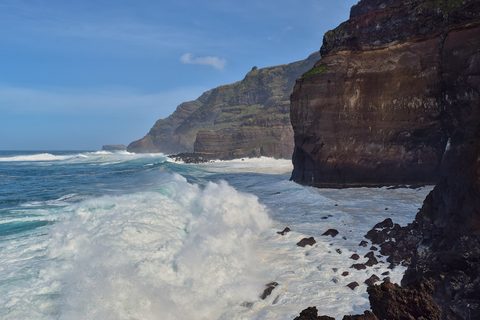
February 2023Waves breaking against the lava cliffs at Ponta da Ferraria.
Photograph: The Cosmonaut, Ponta da Ferraria4, CC BY-SA 2.5, cropped
- Go up to the rim above the two lakes early, and if the cloud is in, wait for it with good grace. It does leave, eventually, and it likes to be thanked.
- Eat the stew from the ground at lunch, slowly. (I set the list down by the steaming holes for a moment, and it came back warm, damp and smelling faintly of cabbage.)
- Watch the pots come up out of the steaming ground by the lake, from wherever the cooks would like you to stand. It is their kitchen, and the ground is busy.
- Drink a cup of the island’s tea where it grows, and thank the people picking it as you pass. It is their working day.
- Leave the car once a day and walk a lane between the blue hedges for no reason at all.
A relic from São Miguel

Relic, entry 278Holes by the lake: 56Time in the ground: six to seven hours
A pot of cozido das Furnas. Beside the lake at Furnas, where fumaroles steam out of the shore, restaurants and home cooks set their pots of stew into the hot ground early in the morning, each in its own hole, and lift them out six to seven hours later. Cooking stews in the ground is a custom there, and this beef stew is the most famous of them.
Tally, in the marginI had thought the pot was the clever part, and admired its lid for some time. Then I saw the long row of other lids along the shore, each in its own patch of steaming ground, and lowered my voice, as one does in somebody else’s kitchen.
Getting there
- 1
Flights from Europe and North America
It is served from Lisbon, Porto and Faro, from other cities in Europe, and from North America: Azores Airlines flies from Boston, Montréal, New York–JFK and Toronto, and United (Newark), Air Canada and WestJet (Toronto) fly seasonally.
- 2
The airport at Ponta Delgada
By air to João Paulo II Airport (PDL), about 2 kilometres west of the centre of Ponta Delgada, which handled nearly 3.3 million passengers in 2024.
- 3
By car round the island
A car is the simplest way round the island; Furnas and Sete Cidades are at opposite ends.
- ✓
When to go. The crater lakes can be seen from the rim only on a clear day; cloud often fills the calderas. CIVISA publishes the Azores’ volcanic alert levels and felt-earthquake notices on its own site.
What to arrange ahead. Ponta Delgada and the island’s other five municipalities charge a tourist tax, a small charge a night, first levied in 2025. Some sites charge entry, among them the Terra Nostra garden’s pool at Furnas and the Caldeira Velha hot springs (tour operators’ listings, indexed; prices not confirmed). For cozido, book lunch at a Furnas restaurant ahead, since the pots go into the ground early in the morning.
Mark this place
The passport stamp for this place.
Common questions
What is São Miguel known for?
São Miguel, the largest island of the Azores in Portugal, is known as the Green Island: for the twin-coloured crater lake of Sete Cidades, the hot springs and fumaroles of Furnas, where cozido stew is cooked in the ground, and the Gorreana tea estate, founded in 1883.
Why are the lakes at Sete Cidades two colours?
The Lagoa das Sete Cidades on São Miguel, in the Azores, is one lake joined by a narrow strait and usually described as two, the Green Lake and the Blue Lake; Wikipedia says each side reflects the light differently. In legend, the lakes are the tears of a princess and a shepherd.
What is cozido das Furnas?
Cozido das Furnas is a beef and vegetable stew cooked in pots set into the hot volcanic ground beside the lake at Furnas, on São Miguel in the Azores. It cooks in the ground for six to seven hours, and the restaurants lift their pots out between 11 a.m. and 1 p.m.
Is the Gorreana tea plantation the oldest in Europe?
Wikipedia calls the Gorreana plantation on São Miguel, in the Azores, founded by Ermelinda Gago da Câmara in 1883, the oldest surviving tea plantation in Europe and one of only two still operating in the Azores.
How do you get to São Miguel from the United States?
João Paulo II Airport in Ponta Delgada, São Miguel, has flights from North America: Wikipedia lists Azores Airlines from Boston, New York–JFK, Montréal and Toronto, and seasonal United flights from Newark.
Is the Furnas volcano active?
Yes: the Furnas volcano on São Miguel, in the Azores, is considered very active. Its last eruption, in 1630, killed 200 people, and today the village cooks its cozido stew in the hot ground beside the lake.
When was São Miguel settled?
Settlers from mainland Portugal reached São Miguel, in the Azores, in 1427, Wikipedia records, although the island’s discovery date is uncertain, somewhere between 1426 and 1437.
How is cozido das Furnas cooked?
In the ground. At Furnas, on São Miguel in the Azores, cooks set pots of the beef stew called cozido das Furnas into the hot volcanic ground by the lake in the early morning, each in its own regular spot, and lift them out cooked hours later.
Photographs on this page
Tap a photograph to see it full size.
Photograph: Navin75, Lagoa do Fogo, CC BY-SA 2.0, cropped
Photograph: Anna Jewels via Unsplash, Unsplash licence
Photograph: Jan Helebrant, CC0
Photograph: Navin75, Gorreana tea estate, CC BY-SA 2.0
Photograph: Chris Slupski via Unsplash, Unsplash licence
Photograph: The Cosmonaut, Ponta da Ferraria4, CC BY-SA 2.5, cropped




