The short answer
Santa Fe is the capital of New Mexico and, by Wikipedia’s account, the oldest state capital in the United States. Its full Spanish name is La Villa Real de la Santa Fe de San Francisco de Asís, the Royal Town of the Holy Faith of Saint Francis of Assisi. Pedro de Peralta founded it, in 1607 by one passage of the article and as capital in 1610 by its infobox. It had 87,505 residents at the 2020 census. Its altitude is the highest of any US state capital; the article gives 6,998 feet in one place and 7,199 feet in another, without reconciling them. New Mexico was admitted as the 47th state in 1912 with Santa Fe as its capital. In 2005 it became the first US city in UNESCO’s Creative Cities Network, for crafts and folk art.
From Tally’s diary
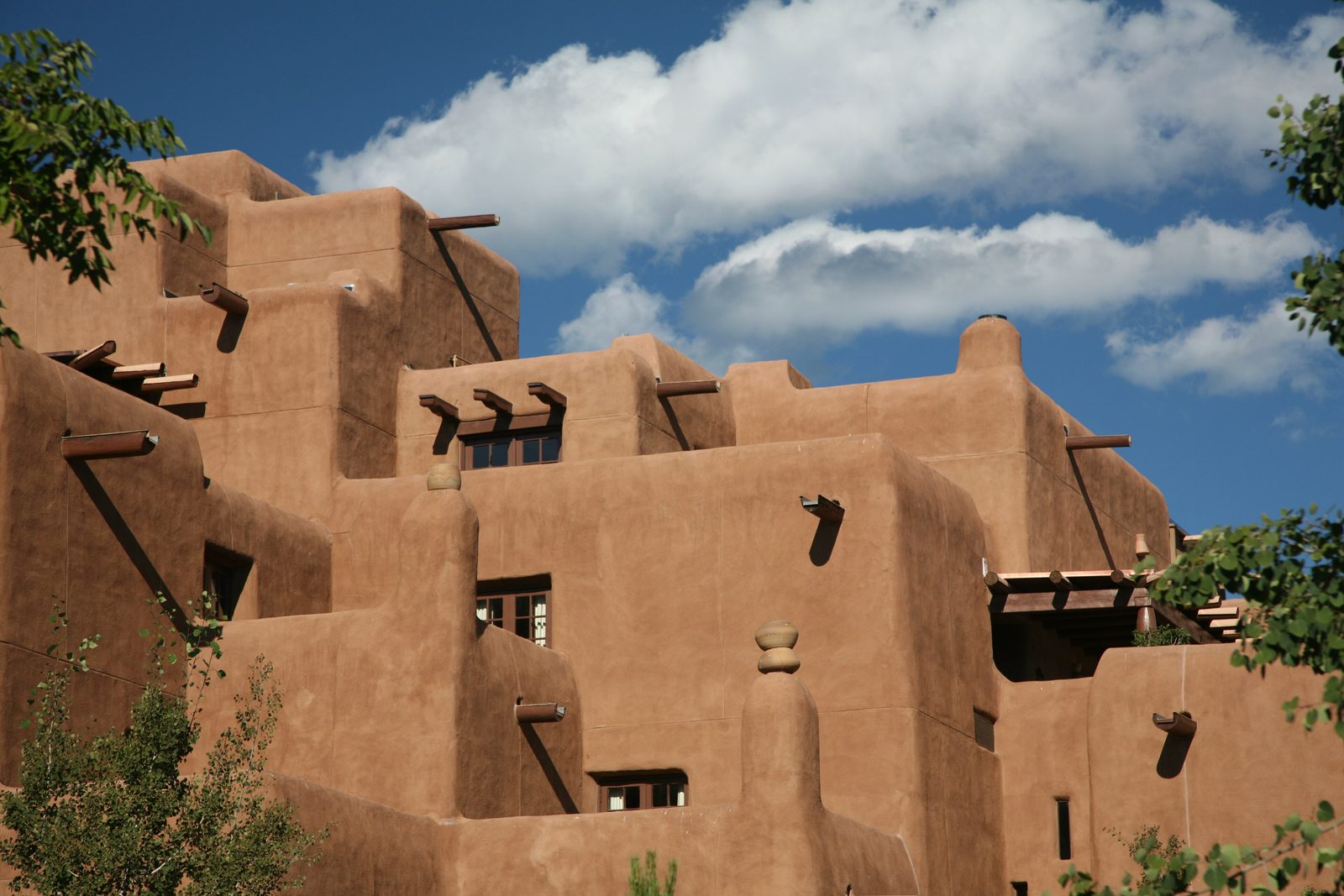
Low brown buildings with soft rounded corners, the same shade as the ground they stood on, and wooden beams sticking out of the walls like the handles of rolling pins. The sky was enormous and very blue, and the air thin enough that I took a bench sooner than planned. Under a long covered walkway, people sat with silver and turquoise laid out on blankets, and did not hurry me.
Why it's worth knowing
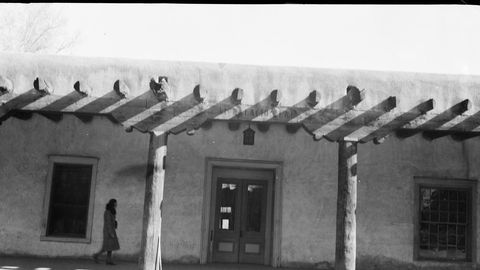
A palace that changed hands. The Palace of the Governors, on the north side of the Plaza, was begun by Peralta in 1610, Wikipedia records, though recent research suggests construction began around 1618; it was the seat of the colony’s government. In 1680 the Pueblo peoples rose and drove the Spanish out, and Pueblo people governed from the palace until 1692, when Diego de Vargas retook the city in what was called the “Bloodless Reconquest”, a name the article notes has been criticised as hiding its violence. The palace became a National Historic Landmark on 9 October 1960; it served as the state history museum from 1909, and the New Mexico History Museum opened beside it in 2009. Under its long portal, Native American artisans sell work they have made themselves, daily from 8:30 a.m. to 5 p.m., the museum says (indexed), in a programme reserved for Native Americans and run under state rules.

March 1934The Palace of the Governors' portal in 1934 (Historic American Buildings Survey).
Photograph: M. James Slack (HABS), Public domain, cropped
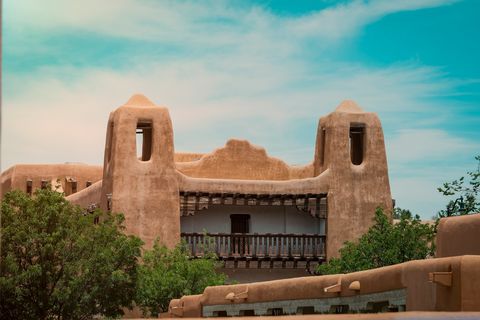
Adobe by decision. In 1912, when the city had about 5,000 residents, its leaders adopted a plan drawing on the City Beautiful movement and historic preservation, Wikipedia records; restorations of the Palace of the Governors and new buildings in traditional styles produced what became the “Santa Fe Style”, and after 1912 it became official. An ordinance passed in 1957 requires new and rebuilt buildings, especially in the designated historic districts, to show a Spanish Territorial or Pueblo style, with flat roofs and features suggestive of traditional adobe. The city’s brown, rounded look is a choice it keeps making.
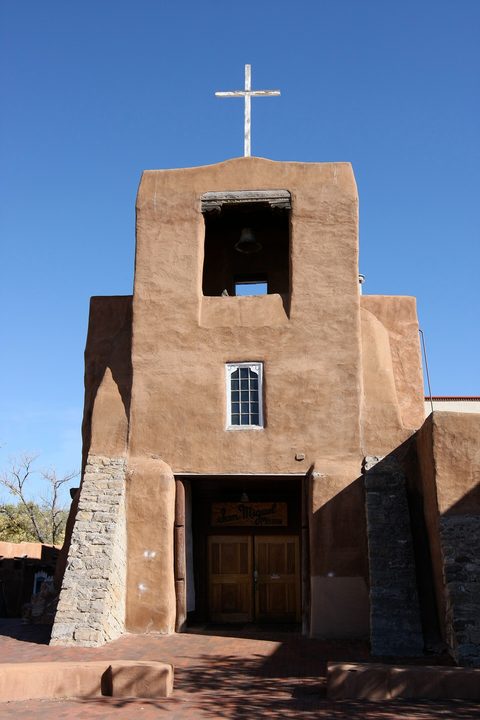
Old churches, and a festival fire. The San Miguel Mission, built in 1610 by the article’s date, is described there as the oldest church in the United States. Canyon Road, east of the Plaza, holds the city’s greatest concentration of galleries, of more than 250 in all. Each September the Fiestas de Santa Fe, begun in 1919, burn Zozobra, a 50-foot marionette; and the Indian Market grew from the Southwest Indian Fair that Edgar Lee Hewett began in 1922.
The field notes
A staircase with a legend
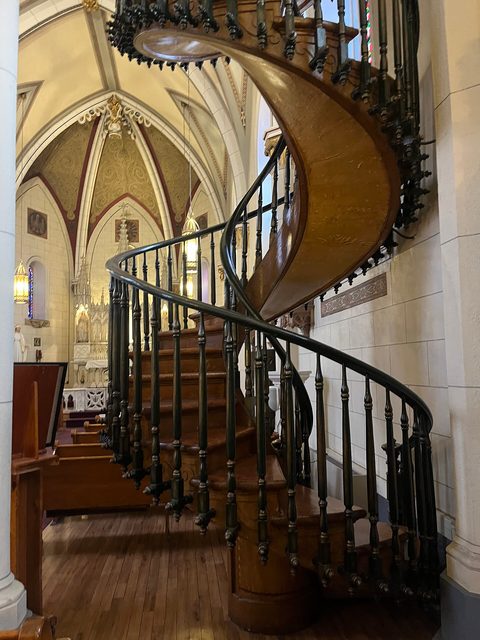
The Sisters of Loretto commissioned their chapel in 1873, to designs by the French architects Antoine and Projectus Mouly, and it was consecrated in 1878, Wikipedia records. Its spiral stair to the choir loft makes two full turns in 33 steps, rises 20 feet, has no central pole, and is held together with wooden pegs, without glue or nails; the railings were added in 1887. In the legend, the Sisters prayed a novena to Saint Joseph, and a stranger arrived, built the stair alone with simple tools and left unpaid and unnamed. In 2002 the historian Mary Jean Cook proposed a French carpenter, François-Jean “Frank” Rochas, as the builder, citing an 1895 newspaper and a logbook entry of 1881; John Clark disputes her reading of the logbook. The chapel is now a privately owned museum and wedding chapel.

September 2024The spiral staircase to the choir loft of the Loretto Chapel.
Photograph: Giewiz, CC BY-SA 4.0

The New Mexico Museum of Art's Pueblo Revival front.
Photograph: Gabriel Tovar via Unsplash, Unsplash licence

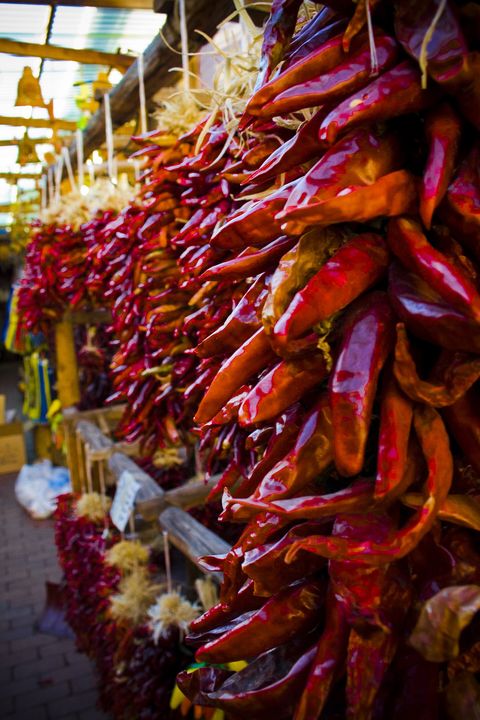
March 2009Strings of dried red chiles hanging under a portal in Santa Fe.
Photograph: Kolin Toney, Chile ristra, CC BY-SA 2.0

October 2009The adobe front of the San Miguel Chapel.
Photograph: Shiny Things, San Miguel Chapel, CC BY 2.0
- Sit on the square late in the afternoon, while the brown walls go gold, and do nothing in particular until they stop.
- Buy from the makers under the long porch, ask about the piece before the price, and ask before a photograph. The table and everything on it are theirs.
- Sit on the plaza in the late afternoon and watch the walls round it turn the colour of toast as the sun goes down.
- Stand under the curly staircase in the little chapel and hunt for the nails. (Found none. The list has since taken a great interest in carpentry and will discuss nothing else.)
- Walk up the road of galleries early, and go into the one you were about to walk past.
A relic from Santa Fe

Relic, entry 272Object: red chile ristraSource: National Park Service
A red chile ristra. A ristra is a string of red chile pods tied together and hung up to dry, and ristras hang “along fences, on patios and on portals all over New Mexico”, the National Park Service says on its page for Petroglyph National Monument, outside Albuquerque. They are sometimes hung for decoration, the page says, but more often to dry for later cooking and eating, and they are said to bring good health and good luck. They are a trademark of decorative design in the state, where large New Mexico chiles are the usual pods.
Tally, in the marginI admired a great many of them as ornaments, doorway after doorway, and was halfway down the street before I understood I had been admiring somebody’s larder. I have looked at every red doorway since as though it might be keeping supper.
Getting there
- 1
The local airport
Santa Fe Regional Airport serves the city.
- 2
Rail Runner from Albuquerque
The larger Albuquerque International Sunport lies to the south-west; the New Mexico Rail Runner Express commuter train runs from Belen through Albuquerque, with a station named for the Sunport, to three stations in Santa Fe, ending at the Santa Fe Railyard; its Sunday service is limited.
- 3
On foot around the Plaza
The historic centre around the Plaza is compact and walkable.
- ✓
| J | F | M | A | M | J | J | A | S | O | N | D |
|---|---|---|---|---|---|---|---|---|---|---|---|
| May: best time | September: best time | October: best time |
- Late spring and autumn are the mild seasons
When to go. Late spring and autumn are the mild seasons; at this height, evenings turn cool. The Fiestas, with Zozobra, are in September.
What to arrange ahead. The Loretto Chapel is privately run and sometimes closes for weddings, and rooms fill early for the Indian Market and the Fiestas.
Safety. The city stands at about 7,000 feet (above). The CDC publishes guidance on travel to high elevations; talk to your doctor before the trip if altitude is a concern.
Mark this place
The passport stamp for this place.
Common questions
Where is Santa Fe?
Santa Fe is the capital of New Mexico, in the south-western United States. It is served by Santa Fe Regional Airport, and the New Mexico Rail Runner Express commuter train links it with Albuquerque, Wikipedia records.
Is Santa Fe the oldest capital in the United States?
Santa Fe, New Mexico, is the oldest state capital in the United States, by Wikipedia’s account: Pedro de Peralta made it the capital of the Spanish colony in 1610, and it became the capital of the state of New Mexico in 1912.
Why do buildings in Santa Fe look like adobe?
Santa Fe, New Mexico, made the Pueblo style official after its 1912 city plan, and an ordinance passed in 1957 requires new and rebuilt buildings, especially in its historic districts, to show a Spanish Territorial or Pueblo style with flat roofs suggestive of adobe, Wikipedia records.
What is the Loretto Chapel staircase?
The Loretto Chapel in Santa Fe, New Mexico, has a spiral stair of two full turns and 33 steps, rising 20 feet, with no central pole and no nails. Legend credits a mysterious stranger; the historian Mary Jean Cook proposed the carpenter François-Jean Rochas in 2002, a reading John Clark disputes.
What is the Palace of the Governors?
The Palace of the Governors, on the Plaza in Santa Fe, New Mexico, was the seat of Spanish colonial government, begun in 1610 or, by recent research, around 1618, Wikipedia records. Pueblo people governed from it between 1680 and 1692. It became a National Historic Landmark in 1960.
What was the Pueblo Revolt?
In 1680 the Pueblo peoples of New Mexico rose and drove the Spanish out of Santa Fe, and Pueblo people governed from the Palace of the Governors until Diego de Vargas retook the city in 1692, Wikipedia records.
How high is Santa Fe?
Santa Fe, New Mexico, has the highest altitude of any US state capital; Wikipedia gives 6,998 feet in one place and 7,199 feet in another.
What is Zozobra in Santa Fe?
Zozobra is a 50-foot marionette burned each September during the Fiestas de Santa Fe in Santa Fe, New Mexico, a festival that began in 1919, Wikipedia records.
Photographs on this page
Tap a photograph to see it full size.
Photograph: Daniel Schwen, CC BY-SA 4.0, cropped
Photograph: Gabriel Tovar via Unsplash, Unsplash licence
Photograph: M. James Slack (HABS), Public domain, cropped
Photograph: Kolin Toney, Chile ristra, CC BY-SA 2.0
Photograph: Giewiz, CC BY-SA 4.0
Photograph: Shiny Things, San Miguel Chapel, CC BY 2.0




