The short answer
Queenstown is a resort town in Otago, in the south-west of New Zealand’s South Island, Wikipedia records, with about 29,000 people in its urban area in June 2025 and 53,800 in the wider Queenstown-Lakes District. It stands on the shore of Lake Wakatipu, with the Remarkables range to the south-east. Its Māori name is Tāhuna, meaning “shallow bay”, and the local iwi is Ngāi Tahu. William Gilbert Rees set up a high-country farm where the town centre now stands in 1860; gold was found in the Arrow River in 1862, and the name Queenstown was adopted on 5 January 1863, likely after Queenstown in Ireland. The town is known for tourism, especially adventure and ski tourism, with four main ski fields nearby: Cardrona, Coronet Peak, the Remarkables and Treble Cone.
From Tally’s diary
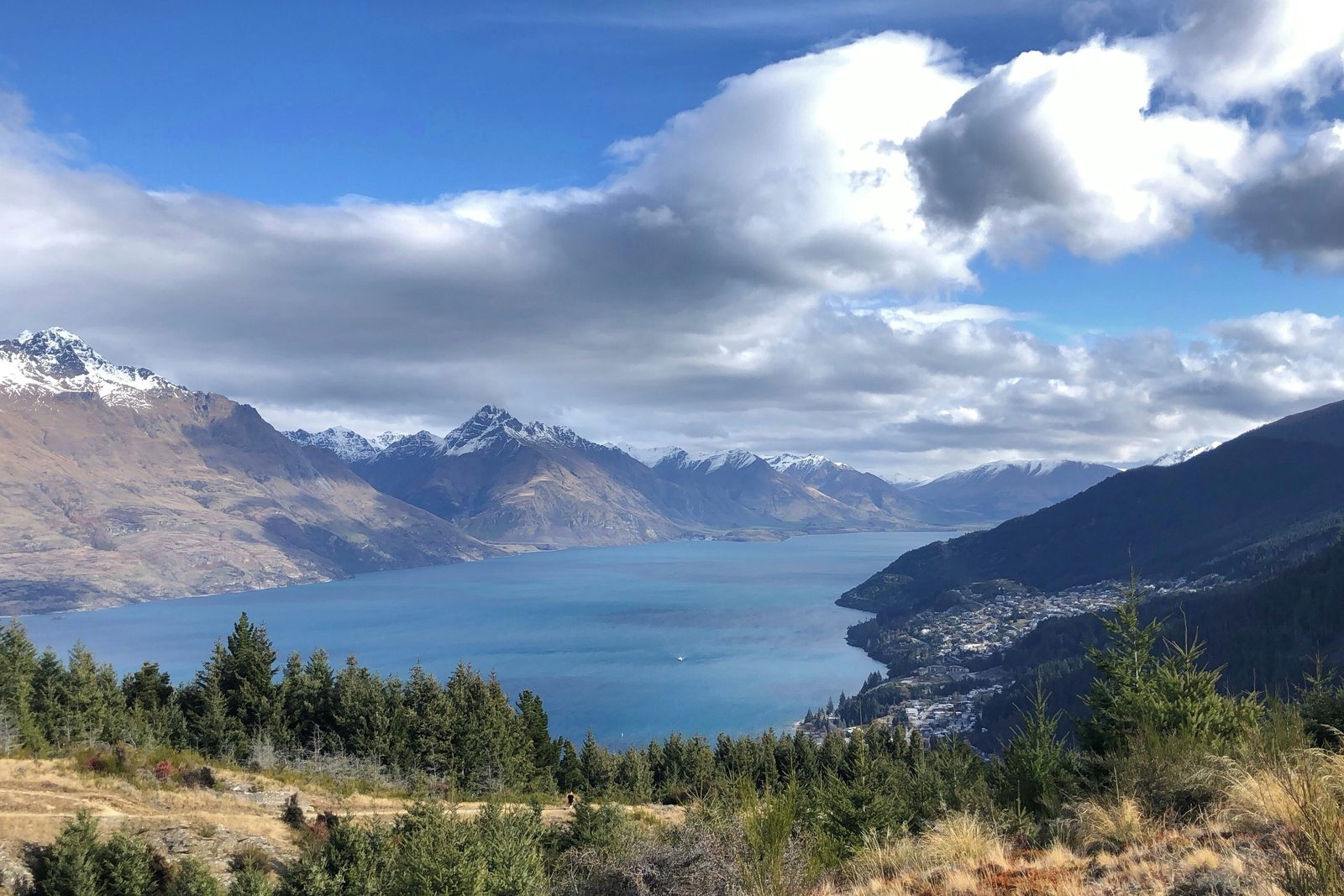
A long lake the colour of a glacier mint, bent like a dropped ribbon between steep brown mountains with snow along their tops. All day people kept throwing themselves off things on purpose, mostly bridges, and came back up laughing. I crossed the lake on an old steamer instead, which smoked politely, hooted once, and went exactly as fast as I would have chosen myself.

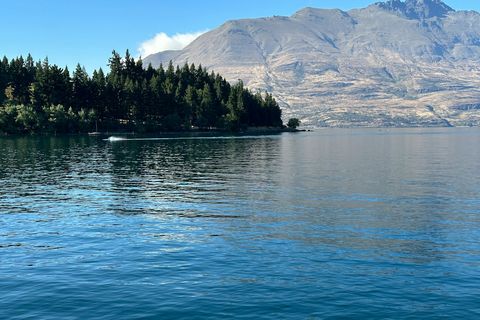
Lake Wakatipu with the Remarkables behind.
Photograph: Gabriel Van Duinen via Unsplash, Unsplash licence, cropped
Why it's worth knowing
The lake that breathes. Lake Wakatipu is New Zealand’s longest lake, 80 kilometres from end to end, and its third largest by area, about 295 square kilometres, Wikipedia records. It is a glacial finger lake in a reversed N or dog-leg shape, up to 420 metres deep, and its floor lies 111 metres below sea level. It has a seiche, a standing wave with a period of 26.7 minutes, that raises and lowers the water in Queenstown Bay by some 200 millimetres. Māori tradition tells of a giant whose breathing makes the water rise and fall, and of a giant who made the lake when he died.

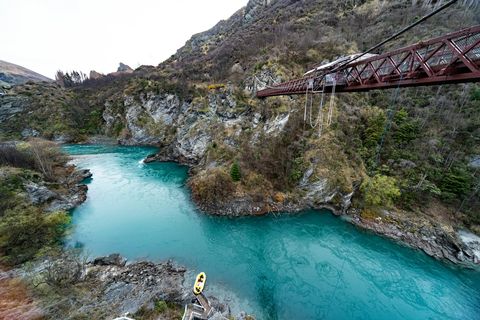
The old Kawarau suspension bridge over the turquoise river, November 2020.
Photograph: Gulfside Mike via Unsplash, Unsplash licence
The bridge where bungy went commercial. The Kawarau Gorge Suspension Bridge was completed in late 1880 as a road into the Central Otago goldfields and stands 43 metres above the Kawarau River, Wikipedia records; it is a Category I historic place. In 1988 A. J. Hackett, who had jumped from the Eiffel Tower in 1987 and was inspired by the land diving of Vanuatu, set up a bungy site on it, which Wikipedia calls the world’s first commercial bungy jumping site. The first modern bungy jumps had been made earlier, on 1 April 1979, by members of the Oxford University Dangerous Sports Club from the Clifton Suspension Bridge in Bristol. The bridge now carries walkers and cyclists on the Queenstown Trail.
When the lake came up. In November 1999 the lake rose from 310.5 metres to 312.77 metres, the most severe flooding in the town’s recorded history, with insurance claims of around $50 million, Wikipedia records.
The field notes
A steamer that still burns coal
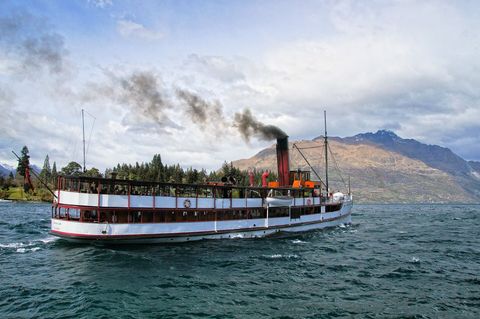
The TSS Earnslaw, a twin-screw steamer 51.2 metres long, was launched on 24 February 1912 by McGregor and Company of Dunedin and made her maiden voyage on 18 August 1912, Wikipedia records; she is named after Mount Earnslaw, a 2,889-metre peak at the head of the lake. She carries passengers on a cruise of about an hour and a half between Queenstown and Walter Peak High Country Farm, and visitors can watch the engines and the stokers at work. The article calls her the only remaining commercial passenger-carrying coal-fired steamship in the Southern Hemisphere, citing the Otago Daily Times in 2009; the engineering plaque awarded by New Zealand’s professional engineers in 1990 says more modestly “one of the world’s last coal-fired passenger steamers”. After her longest survey in 2025, when both engines were overhauled in Invercargill, she was back in service by 1 October 2025, the Otago Daily Times reported.

October 2012The TSS Earnslaw under way on Lake Wakatipu.
Photograph: Bernard Spragg, CC0

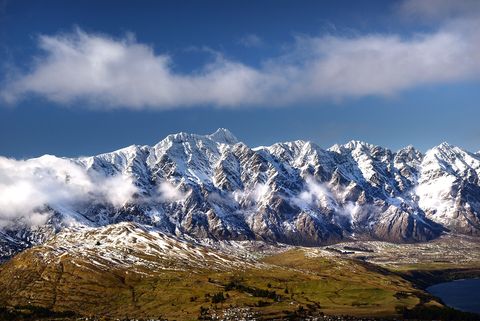
July 2008The Remarkables in winter.
Photograph: Bernard Spragg, CC0
- Watch somebody jump off the old bridge before you decide anything. Then decide slowly, over something to eat.
- Cross the lake on the old steamer and go below to watch the fires being fed. (I offered to help, and was given a seat.)
- Sit at the water’s edge in the bay for a quarter of an hour doing nothing adventurous whatsoever. It counts.
- Learn the town’s other name before you leave, and say it once, carefully, to somebody who will know if you get it right.
- Do one brave thing. (Did one. Added three braver ones on the way down, attempted none of them, and the list, safe in my pocket the whole time, has grown very bold on my behalf.)
A relic from Queenstown

Relic, entry 277Steamer launched: 1912Engineering plaque: 1990
The TSS Earnslaw’s coal. On the steamer, launched on Lake Wakatipu in 1912, stokers still feed her coal, and passengers on the crossing to Walter Peak can watch the engines and the stokers at work. The engineering plaque awarded in 1990 calls her “one of the world’s last coal-fired passenger steamers”.
Tally, in the marginI went below expecting machinery and found people shovelling, with great patience, into a fire that had been moving all of us along the whole time. I came back up and felt I owed the boat an apology for sitting in the sun.
Getting there
- 1
The flight in
By air to Queenstown Airport, at Frankton, which handled about 2.7 million passengers in 2025; Air New Zealand, Jetstar, Qantas and Virgin Australia fly there from Sydney, Melbourne and Brisbane, among other cities.
- 2
The approach between the mountains
The airport is known for its scenery and a challenging approach between the mountains, and it has a 10 p.m. noise curfew.
- ✓
When to go. Summer suits the lake, the walking tracks and the steamer; winter brings the ski season on the four nearby fields. New Zealand sits in an active seismic zone, and a tsunami can follow a nearby earthquake within minutes.
What to arrange ahead. New Zealand charges most international visitors a levy on entry, the International Visitor Conservation and Tourism Levy, paid with the NZeTA or a visa; Australian citizens and most Pacific Islanders are exempt. Adventure activities are sold by many operators in the town; travel insurance policies differ on whether they cover them. Queenstown has no local bed tax, though a 2019 referendum backed one by 81 per cent.
Safety. Serious accidents have happened in adventure tourism, and mountain weather changes fast on the tracks.
Mark this place
The passport stamp for this place.
Common questions
Where is Queenstown?
Queenstown is a resort town in Otago, in the south-west of New Zealand’s South Island, on the shore of Lake Wakatipu, Wikipedia records. About 29,000 people lived in its urban area in June 2025.
Where did bungy jumping start?
The first modern bungy jumps were made from the Clifton Suspension Bridge in Bristol, England, on 1 April 1979, Wikipedia records. The world’s first commercial bungy site opened in 1988 on the Kawarau Gorge Suspension Bridge near Queenstown, New Zealand, set up by A. J. Hackett.
Why does Lake Wakatipu rise and fall?
Lake Wakatipu, beside Queenstown in New Zealand, has a seiche, a standing wave with a period of 26.7 minutes, that raises and lowers the water in Queenstown Bay by some 200 millimetres, Wikipedia records. Māori tradition explains it as the breathing of a giant.
How deep is Lake Wakatipu?
Lake Wakatipu, in Otago, New Zealand, is up to 420 metres deep, and its floor lies 111 metres below sea level, Wikipedia records. At 80 kilometres it is the country’s longest lake.
What is the TSS Earnslaw?
The TSS Earnslaw is a coal-fired twin-screw steamer on Lake Wakatipu, New Zealand, launched in 1912, that carries passengers between Queenstown and Walter Peak High Country Farm; visitors can watch the stokers at work.
What is Queenstown's Māori name?
Queenstown’s Māori name is Tāhuna, meaning “shallow bay”, Wikipedia records; the local iwi is Ngāi Tahu. The English name was adopted on 5 January 1863, likely after Queenstown in Ireland.
Do you have to pay a tourist levy to visit Queenstown?
Most international visitors to New Zealand, including Queenstown, pay the International Visitor Conservation and Tourism Levy, with the NZeTA or a visa. Queenstown itself charges no bed tax.
What are the ski fields near Queenstown?
Wikipedia names four main ski fields near Queenstown, New Zealand: Cardrona Alpine Resort, Coronet Peak, the Remarkables and Treble Cone, and calls the town a major centre for snow sports in New Zealand.
Photographs on this page
Tap a photograph to see it full size.
Photograph: Sarah Precious via Unsplash, Unsplash licence, cropped
Photograph: Bernard Spragg, CC0
Photograph: Bernard Spragg, CC0
Photograph: Gulfside Mike via Unsplash, Unsplash licence
Photograph: Gabriel Van Duinen via Unsplash, Unsplash licence, cropped




