The short answer
Nara is the capital city of Nara Prefecture, Japan, with an estimated 367,353 people in 2022, Wikipedia records. By an edict of 708 the Empress Genmei moved the court there, and as Heijō-kyō it became Japan’s first permanent capital in 710; it remained the seat of government until 784, apart from the years 740 to 745 (the article gives 794 as the end date in one passage). The city was laid out on a grid modelled on the Tang capital at Chang’an. It was designated a city only in 1898. UNESCO inscribed the Historic Monuments of Ancient Nara, among them Tōdai-ji, Kōfuku-ji, Kasuga Grand Shrine and the Kasugayama Primeval Forest, as a World Heritage site in December 1998.
From Tally’s diary
A great wooden hall, dark inside, with a bronze figure so large I had to step back to the door to fit it into my eyes. Outside, deer wandered about the lawns as though they held the lease, and one followed me some way, hoping. Up the hill a long path ran between stone lanterns furred with moss, and the forest at the end of it went quiet.

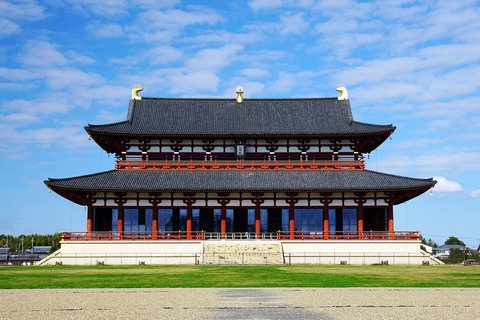
November 2018The Daigokuden at Heijō Palace, on the site of Heijō-kyō, Japan’s first permanent capital.
Photograph: 663highland, CC BY-SA 4.0, cropped
Why it's worth knowing
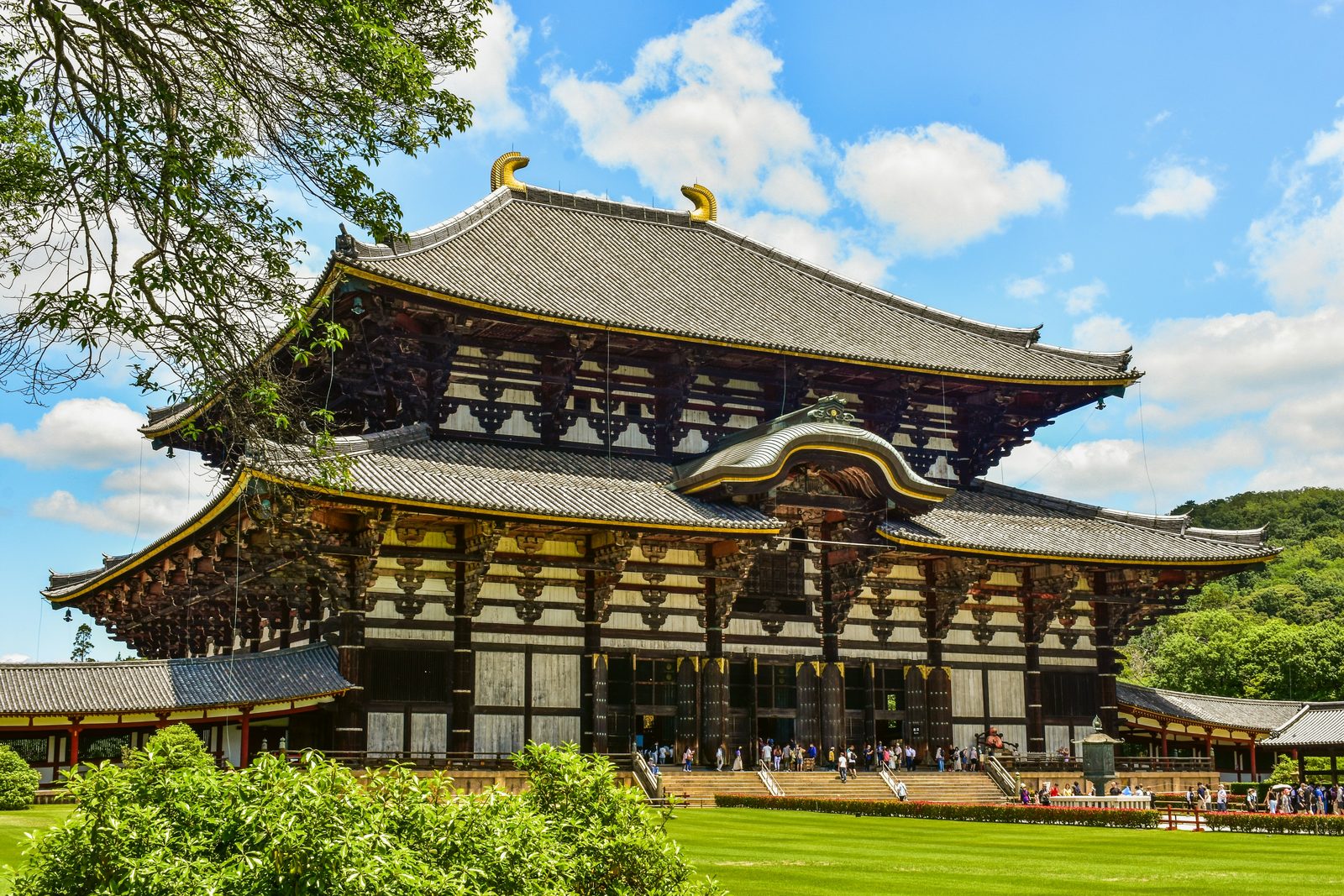
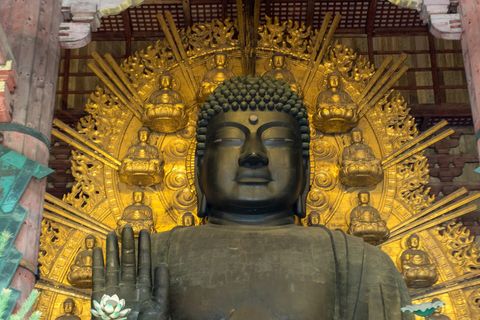
The Great Buddha. After years of disaster and epidemic, Emperor Shōmu commissioned a great bronze Buddha in 743, and Tōdai-ji opened in 752, Wikipedia records. By the temple’s own records, more than 2,600,000 people contributed rice, wood, metal, cloth or labour, 350,000 of them working on the statue itself, which stands 16 metres high and was cast in eight stages over three years. It has been recast several times; its present hands date from the Momoyama period. The Great Buddha Hall, rebuilt twice after fire, was finished in its present form in 1709: 57 metres long, 50 wide and 49 high, it is about 30 per cent smaller than the hall before it, and it was the largest wooden building in the world until 1998. One of its supporting posts has a hole said to be the size of one of the Buddha’s nostrils, and legend holds that those who pass through it will be blessed with enlightenment in their next life.

April 2018The Great Buddha of Tōdai-ji.
Photograph: Ajay Suresh, Daibutsuden at the Todaiji Temple - Nara, CC BY 2.0, cropped
Messengers of a god. By local tradition, Takemikazuchi, one of the gods of Kasuga Grand Shrine, arrived on Mount Mikasa riding a white deer, and from then on the deer were held sacred by the shrine and by Kōfuku-ji; killing one was a capital offence until 1637, the last recorded breach, Wikipedia records. After the Second World War they lost their sacred status and were designated a natural monument instead. A genetic study published in 2023 found that the Nara Park deer carry a lineage not found elsewhere on the Kii Peninsula, which split off about 1,400 years ago, close to the shrine’s founding in 768. Visitors buy deer crackers, shika senbei, to feed them, and some deer have learned to bow to receive one.
The field notes
Lanterns in the forest
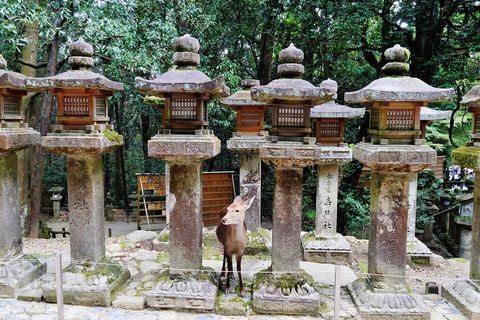
Kasuga-taisha, the shrine of the Fujiwara family, was established in 768 and has been rebuilt several times, Wikipedia records. It is known for the bronze lanterns inside it and the more than three thousand stone lanterns along the way up to it, and its torii is among the oldest in Shinto. The path to the shrine passes through the deer park. The shrine and the Kasugayama Primeval Forest beside it are part of the World Heritage site.

October 2023A young deer among the stone lanterns of Kasuga-taisha.
Too many crackers
Nara Park began in 1880 as 14 hectares in the grounds of Kōfuku-ji, Wikipedia records, and has covered 502 hectares since 1960; with the temple and shrine grounds around it, Nara Prefecture counts 660. The deer grew from about 1,200 in 2008 to 1,465 in 2025, and injuries to people have risen since 2021: a record 121 in 2016, and 159 cases in fiscal 2024, 111 of them involving foreign visitors, Kyodo reported (indexed). A 2009 study found the park’s deer malnourished, living partly on crackers of wheat flour and rice bran. Since 2018 signs in English, Chinese and Japanese have reminded visitors that the deer are wild animals, and in August 2025 Nara Prefecture asked people to avoid touching them unnecessarily, because they carry ticks, Wikipedia records.

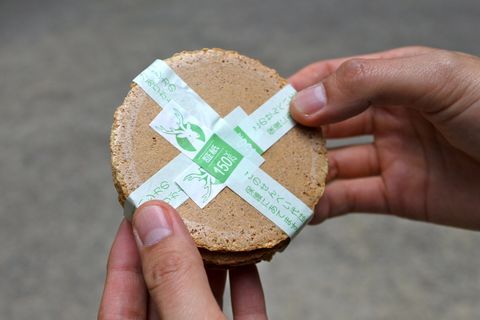
December 2011Deer crackers (shika senbei) in their paper band, Nara Park.

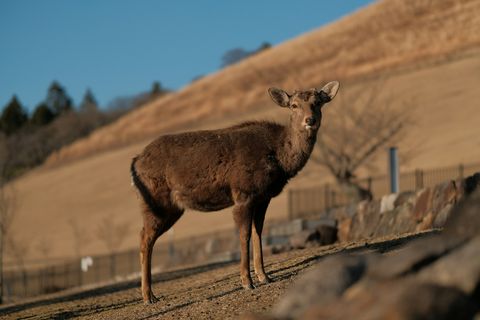
A sika deer on the grass slope below Mount Wakakusa.
Photograph: WL ST via Unsplash, Unsplash licence
- Reach the great hall at opening time, and stand just inside the door a good while before going any further.
- Carry your crackers in one pocket and the list in another. (A deer inspected the list closely, found nothing on it worth eating, and bowed anyway, out of politeness. I added the deer at the bottom in my best writing.)
- Sit on a bench in the park with no crackers at all, and see who comes to visit anyway.
- These are working temples and a living shrine. Speak quietly in the halls, do as others do at the entrances, and step round anyone at prayer.
- Walk the lantern path up to the shrine late in the afternoon, slowly, and count none of them.
A relic from Nara

Relic, entry 281Made of wheat flour and rice branDeer sacred for over a thousand years
A deer cracker. Shika senbei, the plain crackers of wheat flour and rice bran sold in Nara Park, are the visitors’ offering to the park’s sika deer, some of which have learned to bow to receive one. The deer were held sacred as messengers of the god of Kasuga Grand Shrine for more than a thousand years, and are protected today as a natural monument.
Tally, in the marginI held one out and a deer bowed to me, so naturally I bowed back. It bowed again; I returned it; we kept this up for some while before I understood that one of us was bowing for a cracker, and that it was the one with the antlers. I gave it the cracker. I kept the bow.
Getting there
- 1
No airport in Nara
Nara has no airport; the nearest are Kansai International and Itami.
- 2
The Kintetsu line to Kintetsu Nara
Nara Park is served by Kintetsu Nara Station, on the Kintetsu line from Osaka-Namba; JR Nara Station lies about 500 metres to the west of the Kintetsu station.
- 3
On foot between the sights
The temples, the shrine and the park are close together, and the deer are everywhere between them.
- ✓
When to go. The Great Buddha Hall opens from 7:30 a.m. to 5:30 p.m. from April to October, and from 8 a.m. to 5 p.m. from November to March, Tōdai-ji’s site says. The male deer are more aggressive in the autumn mating season: injuries in the park rose to 35 in September 2024 from five a year before, press reports said (indexed). Japan sits in an active seismic zone, with earthquakes and tsunamis.
What to arrange ahead. Tōdai-ji charges admission at the Great Buddha Hall, the Hokke-dō, the Kaidan-dō and the Tōdai-ji Museum, and sells a joint ticket for the hall and the museum. Nara Park itself is open, and its paths are free to walk.
Safety. Earthquakes, tsunamis, floods and volcanic eruptions are among Japan’s natural hazards. In Nara Park, the city’s signs describe the deer as wild animals, and Nara Prefecture has asked visitors not to touch them unnecessarily.
Mark this place
The passport stamp for this place.
Common questions
Why are there deer in Nara?
By tradition, the god Takemikazuchi of Kasuga Grand Shrine arrived in Nara, Japan, riding a white deer, and the deer were held sacred for centuries; killing one was a capital offence until 1637, Wikipedia records. Since the Second World War they have been protected as a natural monument instead.
Do the deer in Nara really bow?
Some do. Wikipedia records that some of the sika deer in Nara, Japan, have learned to bow to receive shika senbei, the deer crackers that visitors buy to feed them in Nara Park.
How big is the Great Buddha of Nara?
The bronze Great Buddha of Tōdai-ji in Nara, Japan, stands 16 metres high, Wikipedia records; it was cast in eight stages over three years, and has been recast several times since; Tōdai-ji opened in 752.
Is Tōdai-ji the largest wooden building in the world?
Not any more. Tōdai-ji’s Great Buddha Hall in Nara, Japan, finished in its present form in 1709 and 49 metres high, was the world’s largest wooden building until 1998, Wikipedia records; modern structures have since surpassed it.
When was Nara the capital of Japan?
Nara, then called Heijō-kyō, was Japan’s capital from 710 to 784, apart from 740 to 745, Wikipedia records; it was the country’s first permanent capital, laid out on the model of the Tang capital at Chang’an.
Do you pay to enter Tōdai-ji?
Yes, for the Great Buddha Hall. Tōdai-ji in Nara, Japan, charges admission at the hall, the Hokke-dō, the Kaidan-dō and its museum, with a joint ticket for the hall and the museum; Nara Park around it is free to walk.
How do you get to Nara from Osaka?
Nara Park, in Nara, Japan, is served by Kintetsu Nara Station on the Kintetsu line from Osaka-Namba, Wikipedia records; JR Nara Station is about 500 metres to the west. The nearest airports are Kansai International and Itami.
How many deer live in Nara Park?
Nara Park in Nara, Japan, had 1,465 sika deer in 2025, a record, Wikipedia records; they roam freely through the park and the grounds of Tōdai-ji, Kōfuku-ji and Kasuga Grand Shrine.
Photographs on this page
Tap a photograph to see it full size.
Photograph: Alex via Unsplash, Unsplash licence
Photograph: 663highland, CC BY-SA 4.0, cropped
Photograph: Ajay Suresh, Daibutsuden at the Todaiji Temple - Nara, CC BY 2.0, cropped
Photograph: WL ST via Unsplash, Unsplash licence