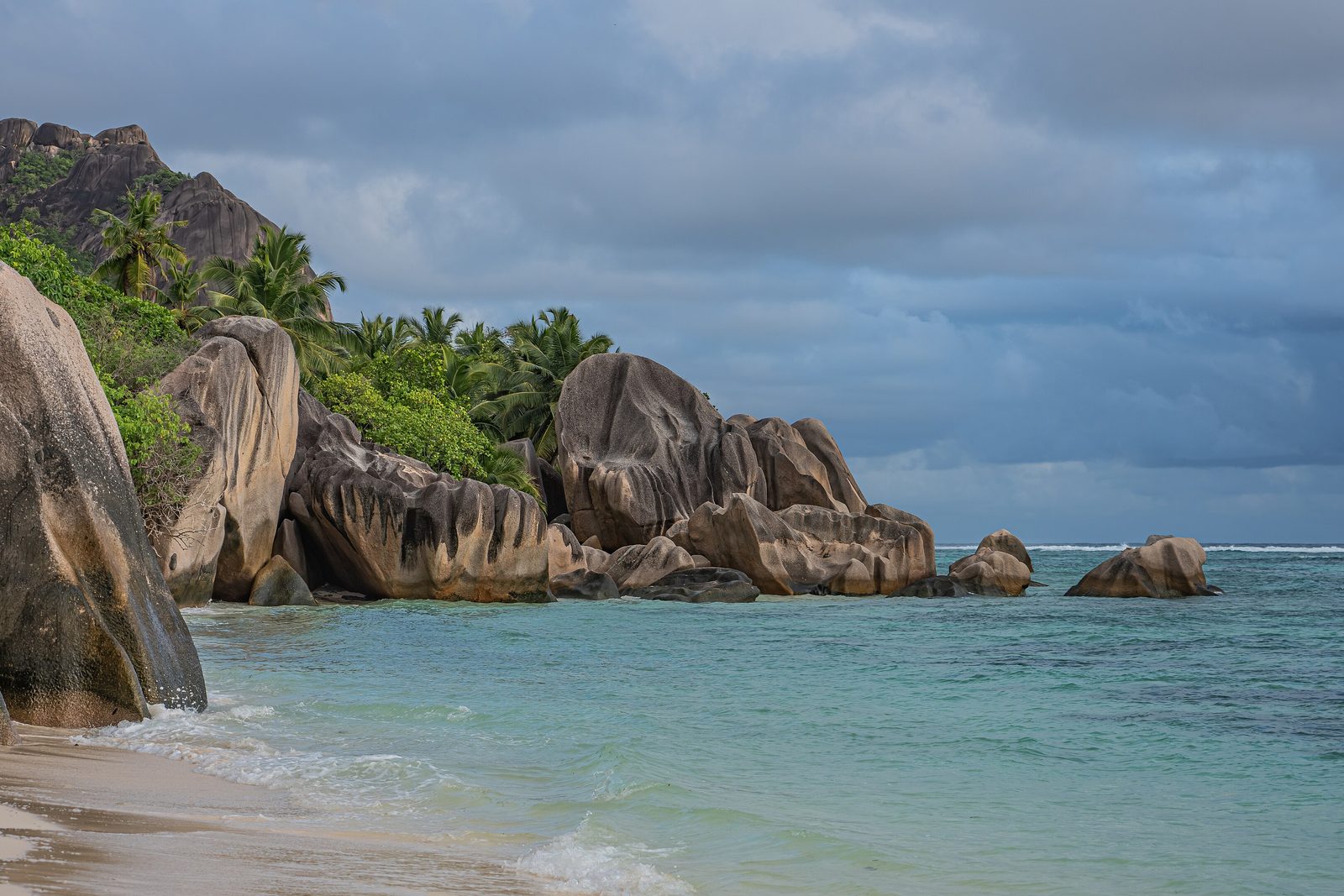
The short answer
La Digue is an island of the Seychelles with an area of 10.08 square kilometres and about 2,800 people, Wikipedia records; it is the country’s third most populous island and the fourth-largest of its granitic islands, after Mahé, Praslin and Silhouette. Most people live in the west-coast villages, chief among them La Passe, the administrative centre, which the ferries link with Praslin and Mahé. Its highest point, Belle Vue or Eagle’s Nest Mountain, rises more than 300 metres in the centre of the island. Tourism is now its main industry, and it is known above all for its beaches, especially Anse Source d’Argent and Grand Anse.
From Tally’s diary
No cars to speak of, only bicycles ringing their bells and a cart drawn by an ox in no particular hurry. The beach was strewn with great grey boulders, smoothed and streaked like elephants left out in the rain, and the water between them was so pale and clear it looked freshly rinsed. A black bird trailing a tail longer than itself crossed the lane.

October 2020A granite boulder at sunset on La Digue's north-west coast.
Photograph: Giles Laurent, CC BY-SA 4.0
Why it's worth knowing
An island at bicycle pace. There is no airport on La Digue; visitors fly to Mahé and continue by ferry, usually via Praslin, Wikipedia records. The bicycle is still the primary means of transport, and bicycles can be rented near the ferry pier; the ox-cart, slow and suited to the island, is another. There are a few privately owned vehicles, but most cars and buses belong to hotel companies.

December 2010The granite boulders of Anse Source d'Argent.
Photograph: Daria, Anse Source d'Argent - panoramio, CC BY 3.0
The boulder beach. Anse Source d’Argent lies on the south-west coast inside L’Union Estate, a historic coconut plantation and vanilla farm, and visitors pay a small entrance fee to the estate to reach it, Wikipedia records. The article says its massive boulders have made it “often considered the world’s most photographed” beach. The island’s early colonists made copra from coconuts and planted vanilla, and the tradition has continued.
The field notes
A bird with a long tail
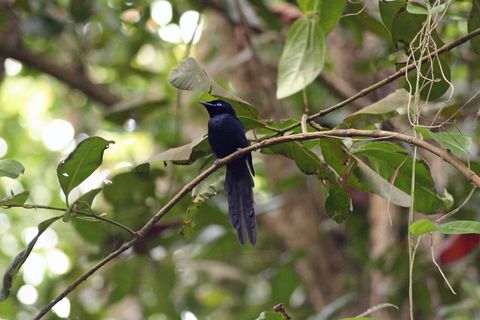
The Seychelles paradise flycatcher, Terpsiphone corvina, is endemic to the Seychelles and native to La Digue, where it lives in the Veuve Nature Reserve in the island’s interior, Wikipedia records; the IUCN lists it as Vulnerable. The males are glossy black, with two long central tail feathers that can reach 30 centimetres. Wikipedia’s two articles give its numbers differently: the island’s says “only about 100” exist, and the bird’s own says numbers are thought to be “in the low hundreds”. In 2008, 23 birds were moved to Denis Island, which has no mammalian predators, and they have bred there. The bird’s article names the main threat as habitat loss on La Digue, from growing tourism and spreading settlement.

July 2008The Seychelles paradise flycatcher, a black male with a long tail.
Photograph: Marion Schneider & Christoph Aistleitner, Public domain
A name from a ship
The French navigator Lazare Picault sighted La Digue in 1742, and it was named in 1768 after La Digue, a ship in the fleet of the French explorer Marc-Joseph Marion du Fresne, Wikipedia records. The first people settled on the island in 1789, when French colonists arrived with enslaved people from Africa; more French deportees followed, and later a large number of liberated slaves and immigrants from Asia, the article records, citing the historian Julien Durup. Visitor numbers on La Digue, as across the Seychelles, rose sharply in the late twentieth century.

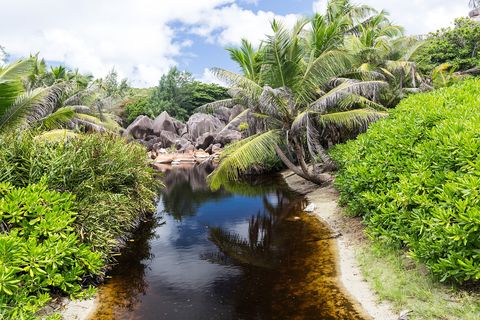
April 2023A tea-dark stream between palms and beach scrub, La Digue.
- Hire a bicycle by the jetty and ring the bell at everybody. As far as I could tell, that is how good morning is said here.
- Go to the boulder beach early, and walk between the rocks before anybody else has photographed them.
- Ride the ox-cart once and let the ox choose the pace. (I read him the list on the way. He stopped twice to consider items, and the list has since lost all sense of urgency.)
- This is a small island, and the lanes run past people’s homes. Ride slowly through the village, keep to the lane, and say good morning as you pass.
- Walk into the forest reserve quietly and wait for the long-tailed black bird. It comes when it pleases, if at all, and it is worth the wait either way.
A relic from La Digue

Relic, entry 283Type: ox-cart, island transportOwner: the island, not the visitor
An ox-cart. La Digue has no airport and few cars, most of them the hotels’; the bicycle is still the main means of transport, and the ox-cart is another, with a slow pace suited to the island. The cart, the ox and the driver are the island’s own; a visitor only rides along.
Tally, in the marginI had it down as the slow way round, and spent the first stretch wishing I had hired a bicycle like everybody else. Somewhere along the second I noticed that every cyclist rang a bell at us going by, and the ox nodded to each in turn, and I understood I had been given the best seat on the island.
Getting there
- 1
Mahé, then the ferry to La Passe
By air to Mahé, then by ferry, usually via Praslin, to the jetty at La Passe; the island has no airport.
- 2
Bicycles for hire at the pier
Bicycles can be rented near the pier.
- ✓
| J | F | M | A | M | J | J | A | S | O | N | D |
|---|---|---|---|---|---|---|---|---|---|---|---|
| January: best time | February: best time | March: best time | April: best time | May: best time | June: best time | July: best time | August: best time | September: best time | October: best time | November: best time | December: best time |
- Best visited All year

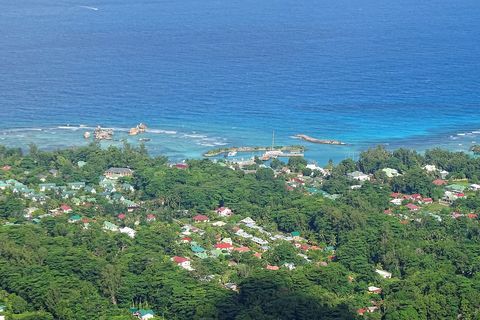
January 2015La Passe's harbour and jetty seen from the hill.
Photograph: Bjørn Christian Tørrissen, CC BY-SA 4.0, cropped
When to go. All year. The rainy season runs from December to March; strong currents and riptides are common in the Seychelles, and most beaches outside the major hotels have no regular lifeguards.
What to arrange ahead. Two charges fall on visitors: L’Union Estate, the only way to Anse Source d’Argent, charges an entrance fee, and the larger places to stay add the Seychelles’ nightly Tourism Environmental Sustainability Levy. Ferry timetables are the operators’ own; aggregator pages disagree on how often the boats run.
Safety. The smaller islands lack the medical facilities of Mahé, and patients are taken there by boat or plane for care.
Mark this place
The passport stamp for this place.
Common questions
Where is La Digue?
La Digue is an island of the Seychelles in the western Indian Ocean, the fourth-largest of the country’s granitic islands after Mahé, Praslin and Silhouette, Wikipedia records. Its ferries run to Praslin and Mahé.
How do you get to La Digue?
La Digue, in the Seychelles, has no airport: visitors fly to Mahé and continue by ferry, usually via Praslin, to the jetty at La Passe, Wikipedia records.
Are there cars on La Digue?
A few. On La Digue, in the Seychelles, the bicycle is still the main means of transport and the ox-cart another, Wikipedia records; there are a few private vehicles, and most cars and buses belong to hotel companies.
Do you have to pay to visit Anse Source d'Argent?
Yes. Anse Source d’Argent, on La Digue in the Seychelles, lies inside L’Union Estate, which charges an entrance fee.
What is the Veuve Nature Reserve?
The Veuve Nature Reserve, in the interior of La Digue in the Seychelles, protects the Seychelles paradise flycatcher, a black bird listed as Vulnerable by the IUCN, whose males have central tail feathers up to 30 centimetres long, Wikipedia records.
How many Seychelles paradise flycatchers are there?
Wikipedia’s article on La Digue says only about 100 Seychelles paradise flycatchers exist, and its article on the bird says the numbers are thought to be in the low hundreds; 23 were moved to Denis Island, Seychelles, in 2008.
How many paradise flycatchers are left on La Digue?
Very few: the Seychelles paradise flycatcher, which lives in the Veuve Nature Reserve on La Digue, is counted at about a hundred to the low hundreds. In 2008, 23 birds were moved to Denis Island, which has no mammalian predators, and they have bred there.
How did La Digue get its name?
La Digue, in the Seychelles, was named in 1768 after La Digue, a ship in the fleet of the French explorer Marc-Joseph Marion du Fresne, Wikipedia records; Lazare Picault had sighted the island in 1742.
Photographs on this page
Tap a photograph to see it full size.
Photograph: A.Savin, Free Art License, cropped
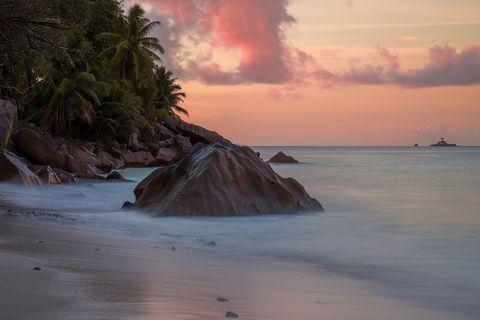
Photograph: Giles Laurent, CC BY-SA 4.0
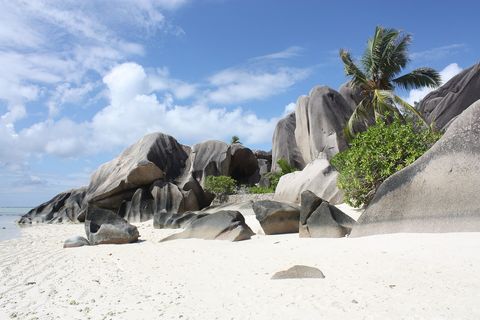
Photograph: Daria, Anse Source d'Argent - panoramio, CC BY 3.0
Photograph: Bjørn Christian Tørrissen, CC BY-SA 4.0, cropped
Photograph: Marion Schneider & Christoph Aistleitner, Public domain




