The short answer
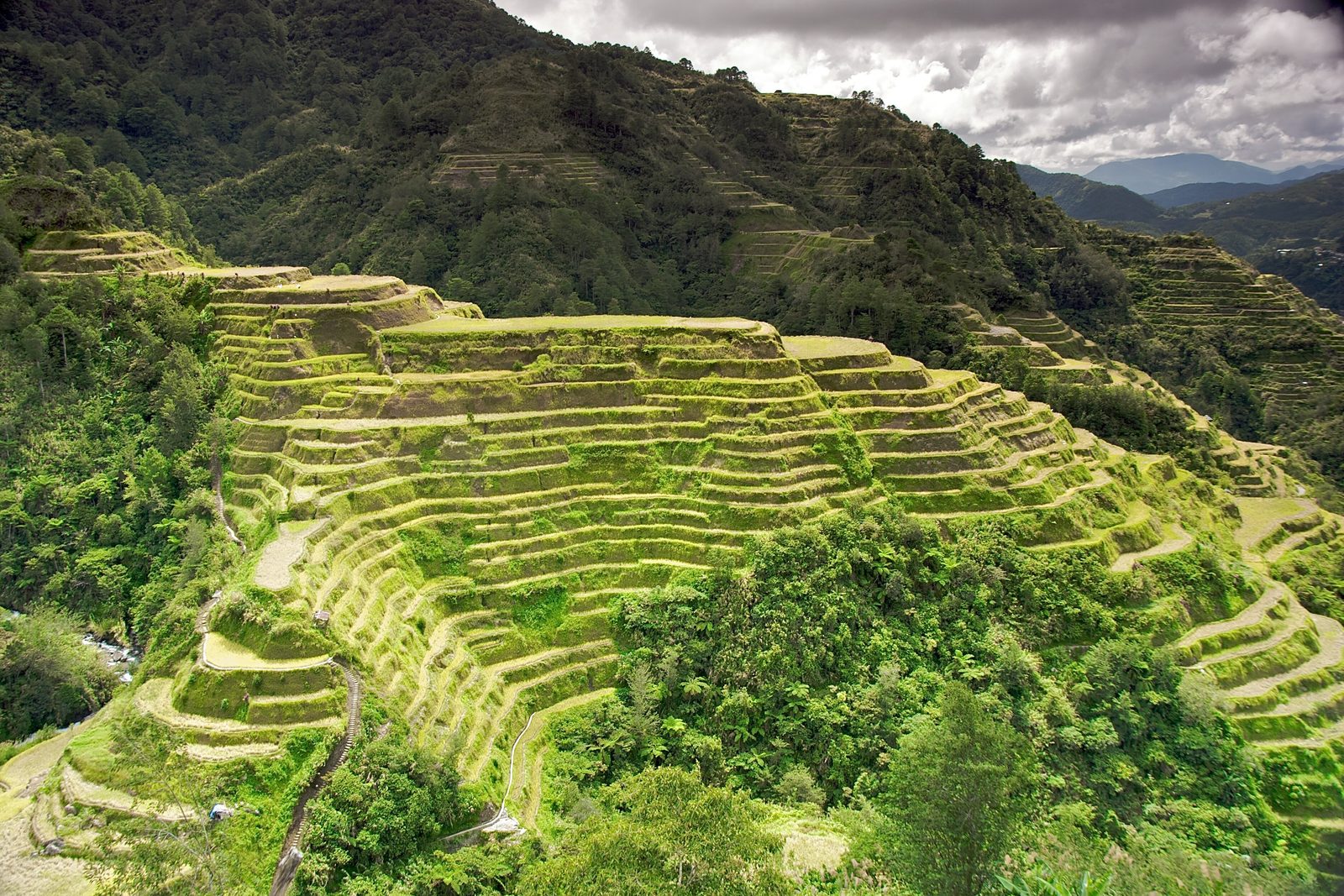
The Rice Terraces of the Philippine Cordilleras are a UNESCO World Heritage Site on the island of Luzon, inscribed in 1995 as the first property ever listed in the cultural landscape category, Wikipedia records. The inscription covers five clusters, all in Ifugao province: the Batad and Bangaan terraces in the municipality of Banaue, Mayoyao Central in Mayoyao, Hungduan in Hungduan, and Nagacadan in Kiangan. The terraces most often photographed, seen from the viewpoint above Banaue town, are not among them: Wikipedia records that they were left out because of the many modern buildings among them, and that they are protected instead as a National Cultural Treasure, by Presidential Decree No. 260 of 1973. The terraces were built, and are still farmed, by the Ifugao people.
From Tally’s diary
The road gave up before I did, and the last of the way was on foot along the tops of walls, with water on one side and a long drop on the other. Then the valley opened like a theatre, every seat a field, and a man on the lowest tier lifted his hat to me, and I waved back from somewhere up in the gods.

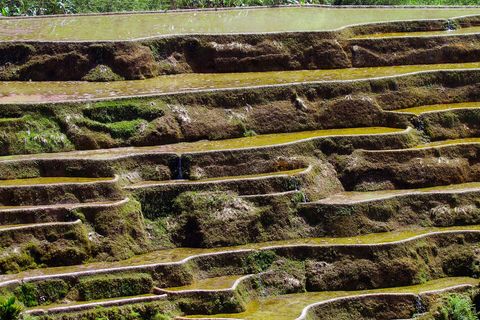
April 2011Terrace walls in Banaue, each narrow step holding a strip of water and rice.
Photograph: Cabajar, Viewpoint Banaue Rice Terraces, CC BY-SA 3.0, cropped
Why it's worth knowing
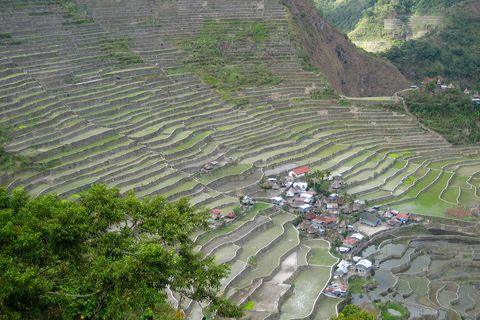
A landscape that works. The terraces are stone- or mud-walled pond fields cut along the contours of the mountains, Wikipedia records, watered by irrigation systems that draw on the forests at the mountaintops. Each cluster is capped by a muyong, a privately owned forest kept under customary practice, which Wikipedia credits with about 264 native plant species; the forests feed the water that keeps the paddies wet all year. The Philippine Star reported in June 2026 that Batad’s terraces rise to about 1,100 metres above sea level like an amphitheatre, and that its heirloom rice is called tinawon, meaning ‘once a year’.

February 2010Batad village in its bowl of flooded terraces.
Photograph: Romain Pontida (Flickr), Rice terraces near Banaue, Batad, Cordillera, North Luzon, Philippines, CC BY-SA 2.0, cropped
Younger than the legend. UNESCO’s page describes the high rice fields of the Ifugao as following the contours of the mountains for 2,000 years, and the American anthropologist H. Otley Beyer put them at more than 2,000 years old, Wikipedia records. The Ifugao Archaeological Project, a research programme of the Save the Ifugao Terraces Movement and the University of California, Los Angeles, reads the evidence differently: its radiocarbon dating, plant remains and historical research showed, it says, that the terraces were built much later than previously assumed, alongside intensified Spanish colonial activity in the lowlands around the seventeenth century. On that reading the terraces were a response to colonial intrusion, built by people who moved into the mountains and stayed out of Spanish control.
The field notes
Twelve years in danger
UNESCO placed the terraces on its List of World Heritage in Danger in 2001, Wikipedia records, with deforestation, climate change and the departure of younger Ifugao from farming among the threats; the Philippines itself sought the listing, to draw support. UNESCO removed them from the Danger List in 2012, recognising improved conservation. The pressures Wikipedia lists have not gone away: giant earthworms and swamp eels that tunnel through the paddy walls, heavy rains from typhoons, farmers shifting from rice to vegetables, and paddies sold or built on for tourism.
The chants and the guardians
The Ifugao’s epic chants, the hudhud, sung mainly by older women at rice sowing, at harvest and at funeral wakes, were proclaimed by UNESCO in 2001 and inscribed in 2008 on its Representative List of the Intangible Cultural Heritage of Humanity, Wikipedia records. The Ifugao are also known for their carving: the bulul, a wooden figure that guards the rice granary, standing for the ancestors.

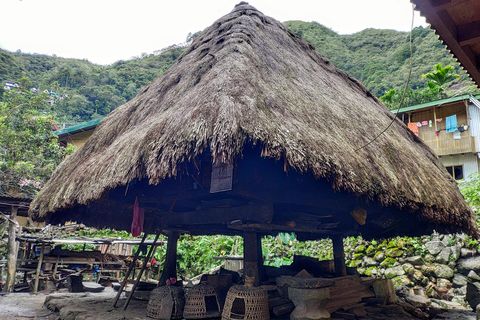
January 2020A thatched Ifugao house raised on wooden posts in Batad village.
Photograph: Ekaterina Kvelidze, CC BY-SA 4.0, cropped

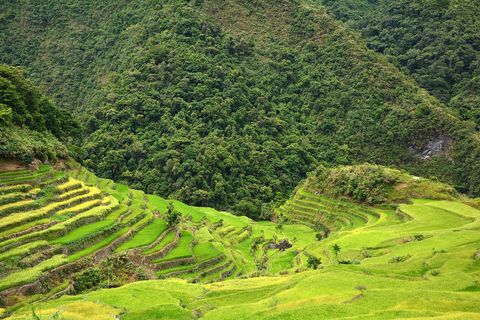
June 2018Young rice on the lower terraces of Batad.
Photograph: Jophel Botero Ybiosa, CC BY-SA 4.0
- Walk on the walls only where the people who farm them walk, and step aside for anyone carrying a load.
- Start early, before the cloud lifts out of the valley, and sit still while it goes.
- Try counting the fields. (I got as far as the first bend, where the hillside folded over and began a whole new set. I have written ‘a great many’ and underlined it twice.)
- Eat the rice when it is offered, and ask its name. It has one.
- At the end of the day, sit on a wall and listen to the water finding its way down from one field to the next.
A relic from the Ifugao Rice Terraces

Relic, entry 297Heirloom rice: tinawon, from BatadReported: June 2026
A bundle of tinawon rice from Batad. Tinawon is the heirloom rice of Batad’s terraces, and the name means ‘once a year’, the Philippine Star reported in June 2026, describing a grain valued for its aroma and grown without pesticides; Batad holds a harvest festival for it. The terraces it grows on are the village’s fields, worked by the families who own them.
Tally, in the marginA small bundle of rice still on the stalk, tied at the neck with a twist of grass. I took it for a souvenir and asked what I owed, and it was well into the afternoon before I understood that nobody was selling it. It was the whole year, tied up in one hand, and I had been holding it upside down.
Getting there
- 1
The road from Manila
By road from Manila to Banaue, about 375 kilometres.
- 2
The overnight bus
Ohayami Trans runs a nightly bus from Manila, about nine to ten hours without road delays, and other overnight buses run from Manila too, with connections through Baguio, Bontoc and Sagada.
- 3
Over the Saddle and on foot to Batad
Batad, the best-known of the five UNESCO clusters, has no road into the village: a jeepney or tricycle runs from Banaue over the pass known as the Saddle, then a walk of twenty minutes or more leads down to the village, where the paths run along the tops of the terrace walls.
- ✓
How to get there. Bangaan is also in Banaue; Mayoyao, Hungduan and Kiangan are separate trips.

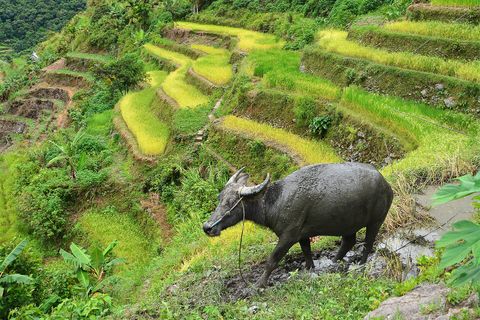
June 2018A water buffalo on a terrace path at Batad.
Photograph: Jophel Botero Ybiosa, CC BY-SA 4.0, cropped
When to go. PAGASA, the Philippine weather service, divides the country’s year into a rainy season from June to November and a dry season from December to May. The Philippine Star reported that Batad held its Tinawon Rice Harvest Festival in June in 2026.
What to arrange ahead. Transport from Manila, a bed in Banaue or in the lodges above Batad, and a guide for the walks between villages, which Wikivoyage recommends hiring in Banaue. Banaue’s Municipal Tourism Office arranges tours and guides, Wikivoyage records. Roads in the Cordillera can be closed by landslides in the rainy season.
Safety. The hazards here are the mountains’ own: steep paths, and rain that brings landslides.
Mark this place
The passport stamp for this place.
Common questions
Where are the Ifugao rice terraces?
The Ifugao rice terraces are in Ifugao province, in the Cordillera mountains of northern Luzon, the Philippines. UNESCO’s World Heritage Site, the Rice Terraces of the Philippine Cordilleras, covers five clusters there: Batad and Bangaan in Banaue, Mayoyao Central, Hungduan, and Nagacadan in Kiangan.
Are the Banaue Rice Terraces a UNESCO World Heritage Site?
Not the ones seen from the viewpoint above Banaue town. Wikipedia records that they were left out of UNESCO’s 1995 inscription because of the modern buildings among them, and are protected as a Philippine National Cultural Treasure; Batad and Bangaan, also in the municipality of Banaue, are inscribed.
How old are the Ifugao rice terraces?
The parties disagree. UNESCO’s page speaks of 2,000 years, as did the anthropologist H. Otley Beyer. The Ifugao Archaeological Project, from the Save the Ifugao Terraces Movement and UCLA, says radiocarbon dating and other evidence show the terraces were built around the seventeenth century, during intensified Spanish activity in the lowlands.
Why were the Ifugao rice terraces on UNESCO’s Danger List?
UNESCO listed the Rice Terraces of the Philippine Cordilleras as in danger from 2001 to 2012, Wikipedia records, with deforestation, climate change and young Ifugao leaving farming among the threats. The Philippines sought the listing to draw support, and UNESCO removed the terraces in 2012, recognising improved conservation.
How do you get to Batad?
By road from Manila to Banaue, about 375 kilometres, then by jeepney or tricycle over the pass called the Saddle and on foot into the village, which has no road, Wikivoyage, the travel wiki, records. Ohayami Trans, which runs the overnight bus from Manila to Banaue, gives the ride as about nine to ten hours without road delays.
What is tinawon rice?
The heirloom rice of Batad’s terraces in Ifugao province, the Philippines. Its name means ‘once a year’, it is valued for its aroma, and Batad holds a harvest festival for it.
What is the hudhud of the Ifugao?
The hudhud is the Ifugao’s cycle of narrative chants, performed mainly by older women at rice sowing, at harvest and at funeral wakes. Wikipedia records that UNESCO proclaimed the Hudhud Chants of the Ifugao in 2001 and inscribed them in 2008 on its Representative List of the Intangible Cultural Heritage of Humanity.
What is a bulul?
A wooden figure carved by the Ifugao of the Philippine Cordilleras to guard the rice granary, standing for the ancestors.
Photographs on this page
Tap a photograph to see it full size.

Photograph: Jose Nicdao (Flickr), Banaue Rice Terraces pic by J. Nicdao - Flickr, CC BY 2.0, cropped
Photograph: Romain Pontida (Flickr), Rice terraces near Banaue, Batad, Cordillera, North Luzon, Philippines, CC BY-SA 2.0, cropped
Photograph: Jophel Botero Ybiosa, CC BY-SA 4.0
Photograph: Jophel Botero Ybiosa, CC BY-SA 4.0, cropped
Photograph: Cabajar, Viewpoint Banaue Rice Terraces, CC BY-SA 3.0, cropped
Photograph: Ekaterina Kvelidze, CC BY-SA 4.0, cropped




