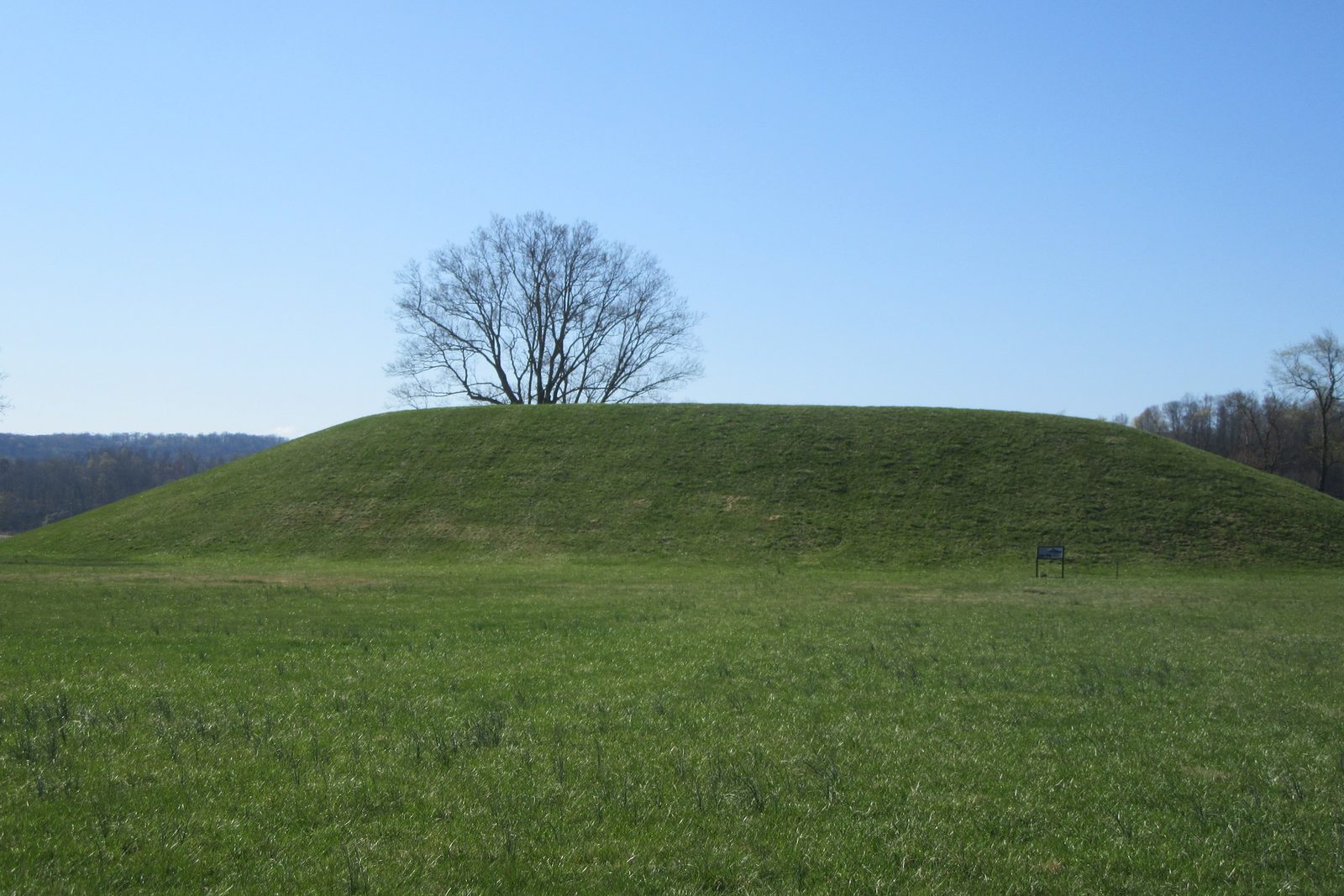
The short answer
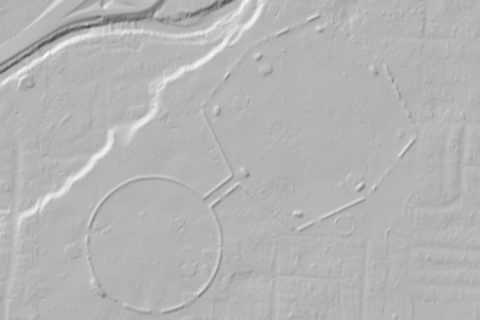
The Hopewell Ceremonial Earthworks are eight monumental earthwork complexes in the Ohio River valley, built between roughly 100 BC and AD 500 and inscribed by UNESCO on 19 September 2023. They include enormous circles, squares, octagons and ellipses of mathematically precise proportion, joined by parallel-walled avenues, together with mound groups holding burials of extraordinary richness. The best preserved is the Octagon at Newark: a fifty-acre octagon connected by a short avenue to a twenty-acre circle. Its walls align to the four moonrise and four moonset limits of the moon’s 18.6-year standstill cycle. The people who built them left no writing, and ‘Hopewell’ is not their name.
From Tally’s diary
Stood in a mown field in gentle farm country looking at grass banks about as high as my shoulder, arranged in shapes far too exact to be accidental. Somebody explained what they line up with and how long that takes to notice, and I had to sit down on one of them.

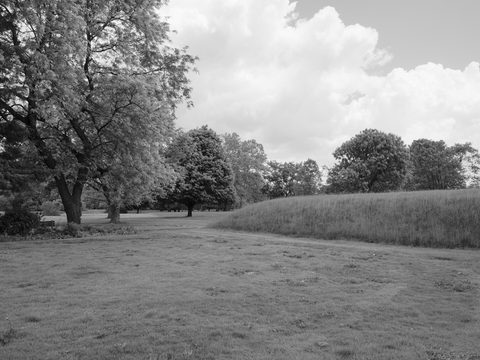
May 2026An embankment of the Octagon Earthworks (black-and-white).
Photograph: Public Lands Institute, CC0
Why it's worth knowing
The sun is easy. It rises within a predictable band, returns to the same limits every year, and a single attentive person can work out the solstices in twelve months. Stonehenge and a hundred other monuments are built on that observation.

August 2026The Octagon and the Observatory Circle in shaded relief from lidar.
Lidar: U.S. Geological Survey 3DEP, Public domain
The moon is not easy. Its rising point on the horizon swings north and south not annually but across a cycle of about 18.6 years, reaching four extreme moonrise positions and four extreme moonset positions. Nothing about a single year reveals the pattern. You cannot notice it in a season, and you can barely notice it in a decade.
The Octagon at Newark is aligned to all eight of those points.
Think about what that requires. Someone had to watch the moon rise, record where on the horizon it appeared, and keep doing it — and then somebody else had to continue after them, and somebody after that, long enough for a shape to emerge from the numbers. Only then could anyone lay out an earthwork to match it. The alignment is not the achievement. The achievement is a research programme run across generations by people with no writing, and completed by a generation who had inherited the answer from ancestors they never met.
The archaeoastronomers Ray Hively and Robert Horn established the alignments in the twentieth century, and the same circle-and-octagon design appears again at High Bank Works, sixty miles away in Chillicothe, oriented to the same cycle. Two of them, sixty miles apart, agreeing.
The field notes
What a standstill is, and why you may never see one
The moon’s orbit is tilted relative to Earth’s path around the sun, and that tilt itself rotates, taking about 18.6 years to come back round. The visible consequence is that the range over which the moonrise wanders along the horizon widens and narrows across that period. At a major standstill the moon rises and sets at its furthest northern and southern points; at a minor standstill the swing is at its narrowest.
Ohio State University’s Newark Earthworks Center puts it plainly: the cycle is visually a nineteen-year rhythm and astronomically about 18.6 years, and on average a person sees three of them in a lifetime. Each standstill is observable by eye for roughly three years around its peak.
The Octagon does not mark one of these points. It marks all eight, and the Great Circle and Observatory Circle are set on further lunar axes. It is less a monument with an alignment than a monument that is an alignment.
A network, not a place
The eight inscribed sites are the surviving centres of something much larger. Objects excavated from Hopewell mounds came from across the continent — obsidian from the Rocky Mountains, marine shell from the Gulf of Mexico, copper from Lake Superior, mica from the southern Appalachians. Archaeologists call the exchange system the Hopewell Interaction Sphere, and its striking feature is that it appears to have been driven by ceremony and belief rather than by conquest or by ordinary commerce.

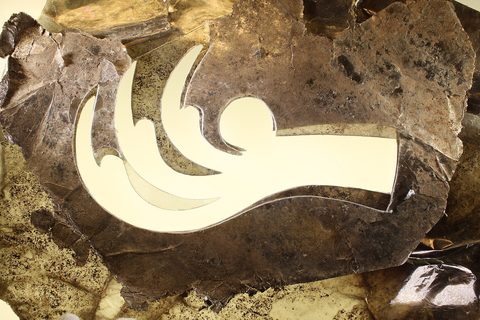
August 2020The sheet left after cutting a modern replica of a Hopewell mica effigy, Hopewell Culture National Historical Park, 2020.
Photograph: National Park Service, Public domain

February 2013Grass-covered mounds of the Mound City Group, Hopewell Culture National Historical Park, Ohio
Photograph: Niagara66, CC BY-SA 4.0
The archaeologist Bradley Lepper has described the Newark Earthworks as the Mecca of the continent, drawing people from societies scattered across half of North America — possibly, he suggests, to gather at the standstill. Figures of up to twenty-eight thousand people at a time appear in that discussion; they are an estimate, and this entry gives them as one.
The original Newark complex covered around four square miles. Most of it is gone, built over by the modern town of Newark from the eighteenth century onward.
The golf course
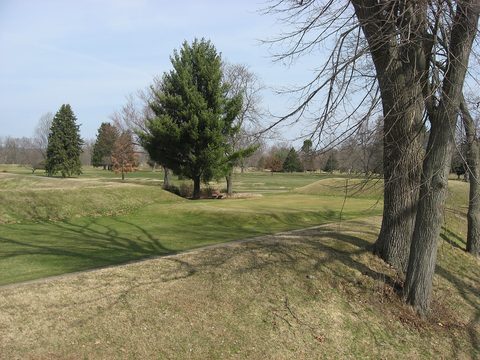
The Octagon Earthworks spent more than a century leased to a private country club and used as a golf course: the Ohio History Connection dates the lease from 1910. Fairways ran between the walls. Access for the public, and for descendant nations, was limited.

March 2011The walls and an opening of the Octagon Earthworks at Newark.
Photograph: Nyttend, Public domain
Chief Glenna Wallace of the Eastern Shawnee Tribe of Oklahoma visited the site and, according to the Smithsonian’s National Museum of the American Indian, was told by a golfer to get out of the way, that she did not belong there. She resolved to have golf removed from the earthwork and to pursue World Heritage status for the whole group. Both campaigns succeeded, the second in 2023.
The Ohio History Connection, which owns the site, pursued its return to full public and ceremonial access through the courts; the Supreme Court of Ohio upheld its right to acquire the lease in 2022. In August 2024 it announced a settlement with Moundbuilders Country Club to buy out the lease for a confidential sum, taking the leasehold on 1 January 2025 and opening the Octagon for full public access from that date. Since then the Octagon grounds have been open to the public in daylight, and public moonrise observances are held there.
The name is somebody else's
‘Hopewell’ is a surname. It belonged to Mordecai Hopewell, a nineteenth-century Ohio landowner on whose farm a mound group was excavated. Archaeology attached the farm’s name to the excavated material, then to the culture, then to a continent-wide exchange network, and now to a World Heritage site.
What these people called themselves is not recoverable. They left no writing. Descendant nations — among them the Eastern Shawnee, and others removed from Ohio in the nineteenth century — have been central to the site’s recent history, and the earthworks are approached today as ancestral rather than as archaeological curiosities.

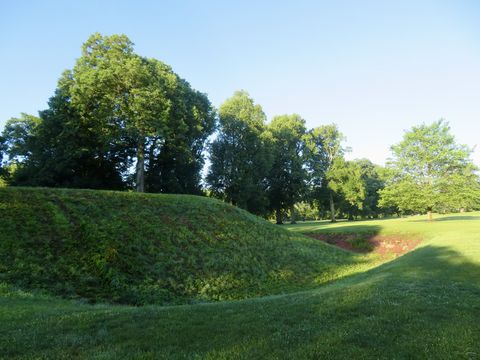
July 2021A grass-covered embankment and ditch at the Newark Earthworks, Ohio.
Photograph: Kyle (Flickr: Kjmagnuson) via Flickr, Newark Earthworks 1, CC BY 2.0
- Look at a survey plan before you go, then walk it.
- Go in low sun. At midday it is a lawn.
- See the Great Circle and the Octagon both, if access allows.
- Walk the banks as ceremonial ground, not as a lawn. Descendant nations worked a long time to see them treated that way.
- Stay for a moonrise if one is being observed. (Brought the list along to take notes. It spent the whole time looking up, like everybody else.)
A relic from the Hopewell Ceremonial Earthworks

Relic, entry 58Room inside for the Great PyramidGateway: nearly 200 feet wide
The wall of the Great Circle. A ring of grassy earth so big the Great Pyramid of Giza would fit inside, heaped up some two thousand years ago. A gateway nearly 200 feet wide leads in. At midday it can pass for a slight rise in a lawn; in low sun the banks throw their shadows and the shape comes back.
Tally, in the marginI took it at first for a long bank at the edge of a field, and only after a while noticed it was curving, and kept on curving, all the way round. Somebody had built a room the size of a field, and I had been standing in the doorway.
Getting there
- 1
The two anchor sites
The two anchors are the Newark Earthworks in Licking County, about forty minutes east of Columbus, and Hopewell Culture National Historical Park near Chillicothe, roughly an hour and a half south of Columbus, which includes Mound City and High Bank Works.
- 2
By car only
Both are reached by car; there is no useful public transport.
- 3
The Great Circle at Newark
At Newark , the Great Circle Earthworks has a visitor centre and open access, and its two-hundred-foot gateway and interior Eagle Mound are the easiest introduction.
- 4
Mound City near Chillicothe
At Chillicothe , Mound City is the most complete mound group open to visitors, with a National Park Service visitor centre and a short loop through the enclosure.
- ✓
| J | F | M | A | M | J | J | A | S | O | N | D |
|---|---|---|---|---|---|---|---|---|---|---|---|
| April: best time | May: best time | June: best time | July: best time | August: best time | September: best time | October: best time |
- April to October
How to get there. The eight sites are spread across central and southern Ohio, and no single visit covers them.

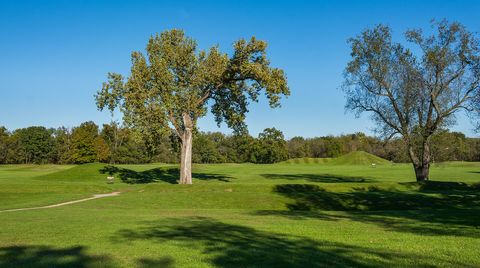
October 2018Grass-covered mounds at Hopewell Culture National Historical Park, seen from near the Mound City Group Visitor Center.
Photograph: Ɱ, CC BY-SA 4.0, cropped
At Newark, the Great Circle Earthworks has a visitor centre and open access, and its two-hundred-foot gateway and interior Eagle Mound are the easiest introduction. The Octagon Earthworks is the astronomically significant one and the one with the complicated recent history; its grounds are open in daylight, and its visitor centre keeps shorter hours of its own.
At Chillicothe, Mound City is the most complete mound group open to visitors, with a National Park Service visitor centre and a short loop through the enclosure.
When to go. April to October gives workable weather and the fullest opening. The earthworks are grass, so they read best in low sun — early morning or late afternoon — when the banks throw shadows. At midday under flat light, a two-thousand-year-old wall six feet high can look like a slight rise in a lawn.
One thing worth knowing before you arrive. These are subtle sites. There is no vertical drama, no ruin, nothing to photograph that will impress anyone who was not there. What is impressive is the geometry, and the geometry is best appreciated from a plan — look at the survey drawings before you go, then walk it.
Mark this place
The passport stamp for this place.
Common questions
What are the Hopewell Ceremonial Earthworks?
They are eight monumental earthwork complexes in the Ohio River valley, built between roughly 100 BC and AD 500 by peoples archaeologists call the Hopewell culture. They include vast circles, squares, octagons and ellipses of precise geometry connected by parallel-walled avenues, together with mound groups containing rich burials. UNESCO inscribed them as a World Heritage Site on 19 September 2023.
What is the lunar standstill cycle, and how does the Octagon track it?
The moon’s rising and setting points swing north and south along the horizon over a cycle of about 18.6 years, reaching four extreme moonrise positions and four extreme moonset positions. The Octagon Earthworks at Newark is aligned to all eight of those limits. Establishing the pattern requires observation over multiple cycles, so the alignment implies recorded observation handed down across generations.
How often does a lunar standstill happen?
About every 18.6 years — visually a nineteen-year rhythm, as Ohio State University’s Newark Earthworks Center puts it — which means an average person sees roughly three in a lifetime. Each standstill is observable by eye for around three years either side of its peak.
Why are they called the Hopewell?
After Mordecai Hopewell, a nineteenth-century Ohio landowner on whose farm a mound group was excavated. The name passed from the farm to the excavated material, then to the culture and its continent-wide exchange network. What the people called themselves is not known; they left no writing.
Is there really a golf course on the Octagon Earthworks?
Not any more. The Octagon was leased to Moundbuilders Country Club, which played golf on it, from 1910 until the end of 2024, according to the Ohio History Connection. The Ohio History Connection, which owns the site, bought out the lease in a settlement announced in August 2024 and took the leasehold on 1 January 2025, opening the Octagon for full public access. The Octagon’s grounds are open in daylight, and the visitor centre keeps its own hours.
Who campaigned for World Heritage status?
Chief Glenna Wallace of the Eastern Shawnee Tribe of Oklahoma was central to the effort. According to the Smithsonian’s National Museum of the American Indian, a golfer told her during a visit that she did not belong at the site, and she resolved both to have golf removed from the earthwork and to pursue World Heritage listing for the whole group. Inscription followed in 2023.
Where did the objects buried in the mounds come from?
From across North America. Excavated Hopewell burials contain obsidian from the Rocky Mountains, marine shell from the Gulf of Mexico, copper from Lake Superior and mica from the southern Appalachians. Archaeologists describe the network that moved these materials as the Hopewell Interaction Sphere, and understand it as driven primarily by ceremony rather than by ordinary trade.
What is at the main Hopewell sites?
The Octagon Earthworks at Newark hold the astronomical alignments, subject to current access. The Great Circle Earthworks at Newark has a visitor centre, a two-hundred-foot gateway and Eagle Mound inside. Mound City, at Hopewell Culture National Historical Park near Chillicothe, is the most complete mound group. The eight sites are spread across three counties.
Photographs on this page
Tap a photograph to see it full size.
Photograph: amanderson2 via Flickr, Seip Mound Hopewell Culture National Historic Park, CC BY 2.0, cropped
Photograph: Nyttend, Public domain
Lidar: U.S. Geological Survey 3DEP, Public domain
Photograph: Public Lands Institute, CC0
Photograph: National Park Service, Public domain
Photograph: Ɱ, CC BY-SA 4.0, cropped
Photograph: Kyle (Flickr: Kjmagnuson) via Flickr, Newark Earthworks 1, CC BY 2.0
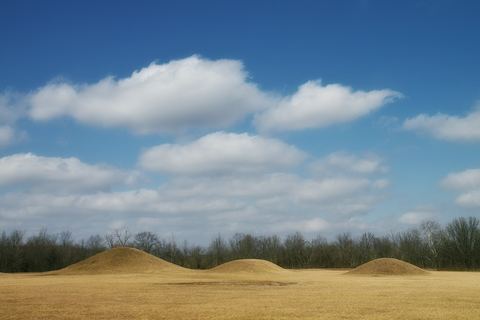
Photograph: Niagara66, CC BY-SA 4.0




