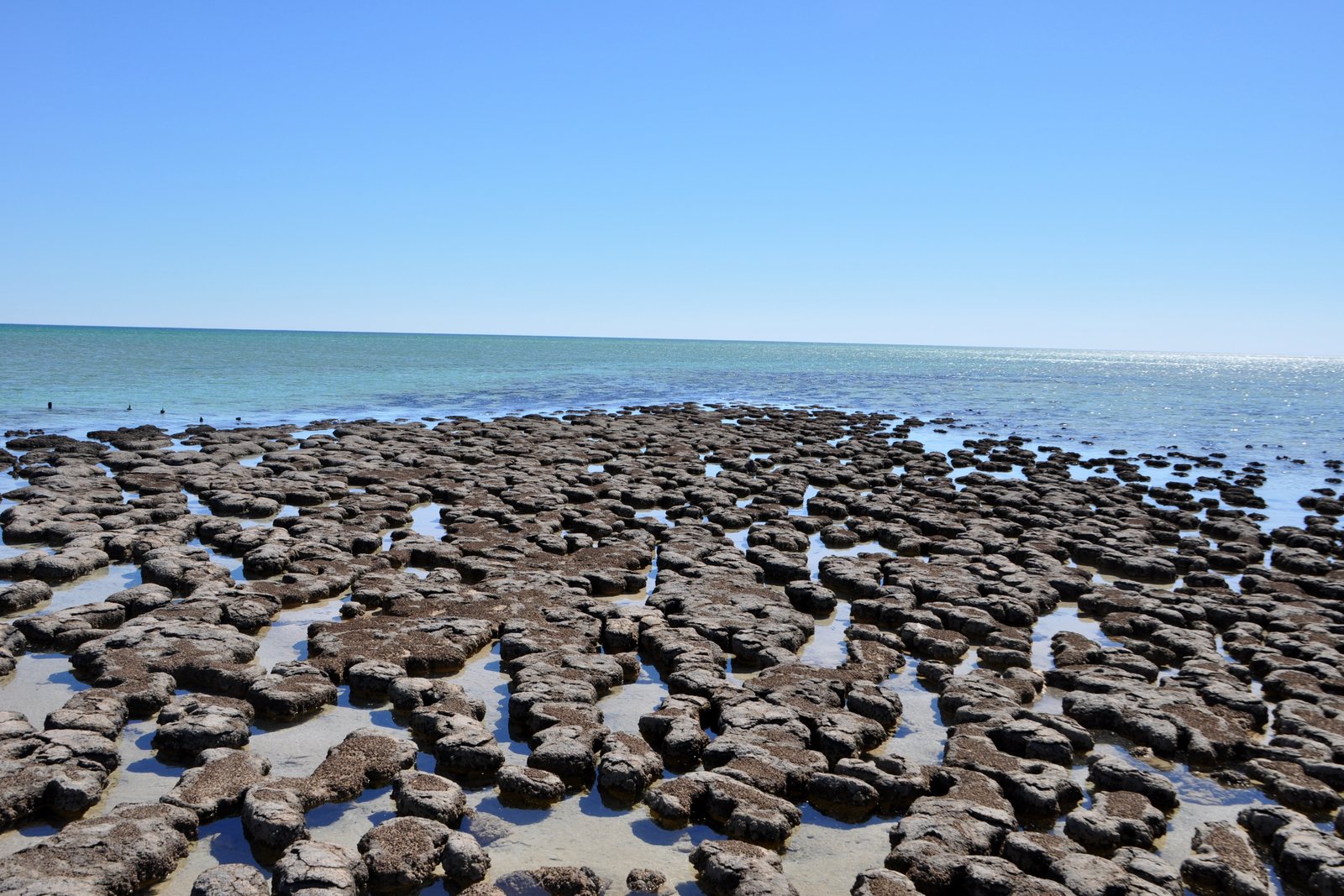
The short answer
Hamelin Pool is a shallow, enclosed arm of Shark Bay on the coast of Western Australia, and Western Australia’s parks department calls it one of only two places in the world with living marine stromatolites; the other is the Exuma Cays in the Bahamas. Stromatolites are not individual organisms. They are layered, rock-like structures built by mats of cyanobacteria, which trap and bind sediment and then grow up through it toward the light, adding a layer at a time. The oldest fossil stromatolites, found east of Marble Bar in Western Australia, are dated at about three and a half billion years, and for more than three billion years of that span, the department says, such structures dominated marine ecosystems. Hamelin Pool sits inside the Shark Bay World Heritage Area, inscribed by UNESCO in 1991.
From Tally’s diary
Drove a long way to look at some grey lumps in very salty water, which is what they are, and stood there for an hour anyway. Somebody explained what they had made and roughly when, and I found myself thanking them out loud, which the other visitors did not comment on. The water fizzes. That is them, still working.

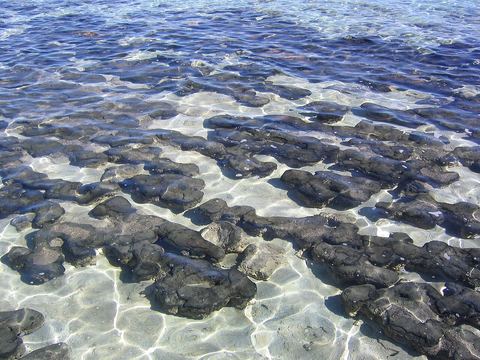
May 2004Stromatolites in the shallows of Hamelin Pool.
Photograph: Phil Whitehouse, Hamelin Pool (Stromatolites), CC BY 2.0
Why it's worth knowing
These are the organisms that made the atmosphere.
Before cyanobacteria, the air held around one per cent oxygen. Photosynthesising microbial mats then spent something like two billion years releasing oxygen into the oceans — the ocean absorbed it, then the ocean saturated, and the surplus went into the air. What is now roughly twenty per cent oxygen, and every animal that has ever breathed, follows from that. You can still watch it happening: on a bright day the stromatolites at Hamelin Pool visibly fizz, letting go of bubbles.
And here is the strange part.
Stromatolites were once everywhere. What ended them was the thing they had made possible: once there was enough oxygen for animals, animals evolved, and animals eat microbial mats. Grazing removed stromatolites from almost every coastline on Earth.
Hamelin Pool is one of the few places they were not reached. A bank of seagrass across the entrance restricts the flow of water in and out, evaporation does the rest, and the pool has become about twice as salty as open seawater. The salt keeps out the marine life that would otherwise feed on the mats. The oldest form of life on the planet survives in the one condition harsh enough to keep its descendants out.
They will not impress you at a glance. Bush Heritage Australia admits that from the shore they look a little like cow pats. That is accurate, and it is beside the point. What you are looking at is the oldest form of life on Earth, doing the job that made you.
The field notes
How a rock grows
A stromatolite is built rather than born, and the mechanism is worth understanding because it explains the shape.

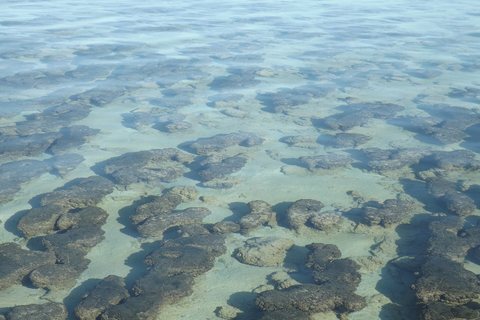
November 2013Stromatolite heads under clear, shallow water.
Photograph: Summerpuss, CC BY-SA 4.0, cropped
Cyanobacteria form a sticky mat on the sea floor. Sediment settles on it and gets trapped. The mat is now buried and cut off from sunlight, which it needs, so it grows upward through the sediment to reach the light again — forming a new living layer on top of the old one. Then sediment settles again. Repeat, for a very long time.
The result is a domed or cauliflower-shaped column of thin laminations, of which only the top few millimetres are alive. Everything below is the hardened remains of previous mats. Typical growth is about half a millimetre a year, so a column a metre high stands for something like two thousand years of that cycle.
So the object in front of you is simultaneously a living organism and its own fossil record, stacked.
Why here, and almost nowhere else
The geography is doing all the work.

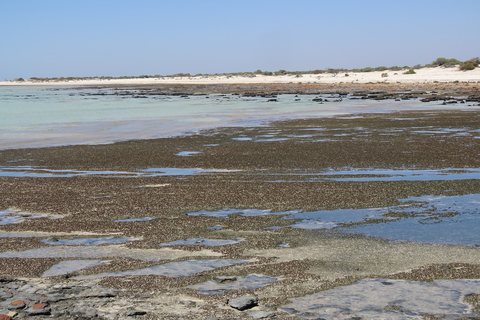
January 2018Low water across the Hamelin Pool flats, the dunes of the shore beyond.
Photograph: Donald Hobern, Hamelin Pool, CC BY 2.0, cropped
Hamelin Pool is nearly cut off from the rest of Shark Bay by a bank of dense seagrass, which restricts tidal exchange. The water that does enter sits in a shallow basin in a hot, dry climate and evaporates faster than it is replaced. The salt stays. Salinity settles at roughly double that of normal seawater.
Western Australia’s Department of Biodiversity, Conservation and Attractions calls Hamelin Pool one of only two places in the world with living marine stromatolites, and Bush Heritage Australia says it holds exceptionally diverse and abundant stromatolite forms. The other place is the Exuma Cays in the Bahamas.
The dependence on that seagrass bank is also the vulnerability. Seagrass meadows in Shark Bay have been damaged by flood runoff and marine heat events, and if the barrier degrades, the pool circulates, the salinity falls, and the grazers arrive. The thing that has protected these colonies is not the reserve boundary. It is the salt, and the salt depends on plants.
Looking, not walking
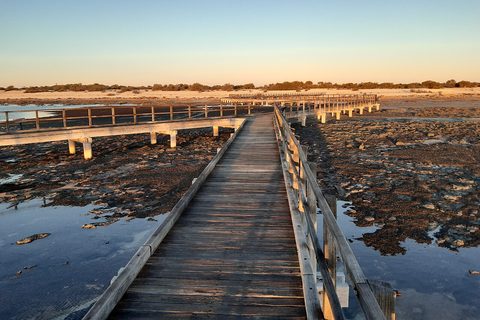
In 1996 a timber boardwalk 230 metres long was built out over the stromatolites, and in 2021 Cyclone Seroja battered it. The microbial mats themselves are far too fragile to be walked on: walking below the high-water mark, swimming and snorkelling are not permitted in the reserve.

July 2020The boardwalk over the stromatolites at Hamelin Pool.
Photograph: Calistemon, CC BY-SA 4.0, cropped
From the shore the stromatolites show best at low tide, and the department suggests binoculars. The Boolagoorda Trail, a 1.4-kilometre loop from the Telegraph Station, passes gravesites, the old telegraph line and a historic shell block quarry.
Beside the reserve stands the Hamelin Pool Telegraph Station, built in 1884 to connect Shark Bay to the rest of the world, and now a privately run museum with a stromatolite display. It is worth twenty minutes, and there is a certain symmetry in a nineteenth-century communications relay sitting next to the oldest living thing on the coast.
A bay that qualified on every count
Shark Bay is inscribed against all four of UNESCO’s natural criteria — for its earth history, its ongoing ecological processes, its natural beauty, and its biodiversity. The stromatolites carry a good deal of that weight, but they are not alone.

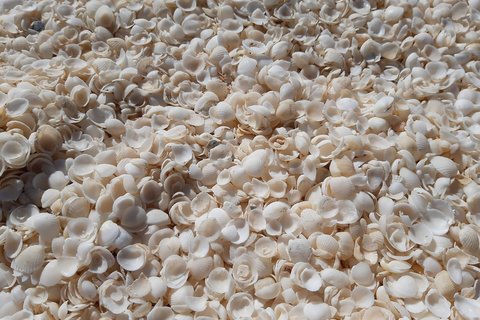
July 2020Shell Beach: not sand but billions of small cockle shells.
Photograph: Calistemon, CC BY-SA 4.0, cropped
UNESCO’s listing names one of the largest and most diverse seagrass beds in the world; the bay also holds a dugong population in the thousands, and Shell Beach, where the beach is not sand at all but coquina — the shells of a single cockle species, Fragum erugatum, which thrives in the hypersaline water, packed seven to ten metres deep. Before the World Heritage listing, coquina was quarried in blocks and used for buildings in Denham.
The same salt that preserves the stromatolites produced a beach made of shells and a town partly built out of it.
- Come at the lowest tide of the day, not the most convenient one.
- Bring binoculars. From the shore, they are a grey smudge without them. (So, from a distance, is the list.)
- Read the signs before looking, not after.
- Go to Shell Beach afterwards and pick up a handful.
- Say thank you. It is not silly. They earned it.
A relic from Hamelin Pool

Relic, entry 61Origin: Shell Beach, Shark BayUsed for: buildings in Denham
A block of shell. At Shell Beach the coquina compacts into a solid mass that can be cut in slabs, and buildings in Denham were made of it — walls of nothing but tiny shells, cemented by time. It is a building material produced by the same salinity that keeps the stromatolites alive: one condition, two entirely different consequences.
Tally, in the marginA wall made of nothing but shells, held up by time. The same salt did both of these things and I cannot stop thinking about it.
Getting there
- 1
The long drive north
Shark Bay is about 800 km north of Perth.
- 2
From the roadhouse to the pool
Hamelin Pool is 100 km south-east of Denham and 35 km from the Overlander Roadhouse on the North West Coastal Highway; access is through the Telegraph Station grounds, and entry is free.
- 3
No public transport
There is no public transport; this is a self-drive or organised-tour destination.
- 4
Low tide
The best time to see the stromatolites from the fence is at low tide, when more of the colonies stand clear of the water.
- ✓
| J | F | M | A | M | J | J | A | S | O | N | D |
|---|---|---|---|---|---|---|---|---|---|---|---|
| April: best time | May: best time | June: best time | July: best time | August: best time | September: best time | October: best time |
- April to October
How to get there. Most visitors come as part of a Shark Bay trip taking in Denham, Monkey Mia and Shell Beach.
Time it with the tide. The best time to see the stromatolites from the fence is at low tide, when more of the colonies stand clear of the water. Tide tables matter more here than time of day.
When to go. April to October. Summer in the Gascoyne is severe, and the walk to the viewing area is exposed with no shade.
What to bring. Binoculars or a telephoto lens, which turn a distant grey lump into a visibly layered structure. Water. Sun cover. And realistic expectations, followed by the interpretive signs, in that order — this is a place that rewards understanding rather than looking.
Do not walk on them. Walking below the high-water mark is not permitted, to protect the mats, and neither are swimming, snorkelling or fishing.
Mark this place
The passport stamp for this place.
Common questions
What are the stromatolites at Hamelin Pool?
They are layered, rock-like structures built by mats of cyanobacteria — not individual organisms but colonies. The microbes trap and bind sediment, then grow upward through it toward sunlight, adding a living layer on top of the old one. Repeated over centuries this builds domed columns of which only the top few millimetres are alive.
Why are stromatolites important?
Because they made the atmosphere breathable. Before cyanobacteria the air held around one per cent oxygen. Photosynthesising microbial mats released oxygen into the oceans for roughly two billion years; once the water saturated, the surplus entered the air. The roughly twenty per cent oxygen that animal life depends on follows from that process.
Why do stromatolites survive at Hamelin Pool and almost nowhere else?
Because the water is too salty for the animals that would eat them. A seagrass bank across the entrance restricts tidal exchange, and evaporation in a hot dry climate raises salinity to about twice that of open seawater. Grazing animals eliminated stromatolites from most of the world’s coastlines; here they cannot survive to do so.
Where else in the world can you see living marine stromatolites?
Western Australia’s parks department calls Hamelin Pool one of only two places in the world with living marine stromatolites; the other is the Exuma Cays in the Bahamas. Bush Heritage Australia says Hamelin Pool holds exceptionally diverse and abundant stromatolite forms.
What happened to the Hamelin Pool boardwalk?
Cyclone Seroja damaged it in 2021. The timber boardwalk at Hamelin Pool, in Western Australia’s Shark Bay, was built out over the stromatolites in 1996 and ran 230 metres; the microbial mats themselves are far too fragile to be walked on.
Can you still see the stromatolites without the boardwalk?
Yes, from the shore at Hamelin Pool. The Western Australian parks department says the best time is low tide and encourages binoculars. Walking below the high-water mark is not permitted. It is a less immersive view than the boardwalk offered, but the colonies are visible.
How old are the Hamelin Pool stromatolites?
Two different ages are relevant. The oldest fossil stromatolites, found east of Marble Bar in Western Australia, are dated at about 3.5 billion years, and the parks department says such structures dominated marine ecosystems for more than 3 billion years. The individual columns at Hamelin Pool are far younger: at a typical growth of about 0.5 mm a year, a metre-high column stands for around two thousand years.
What is Shell Beach at Shark Bay?
A beach in Shark Bay made not of sand but of shells of a single cockle species, Fragum erugatum, which thrives in the hypersaline water of L’Haridon Bight. The shells cover about 60 kilometres of shore to a depth of seven to ten metres, and the coquina they form was quarried for buildings in Denham before the World Heritage listing.
Photographs on this page
Tap a photograph to see it full size.
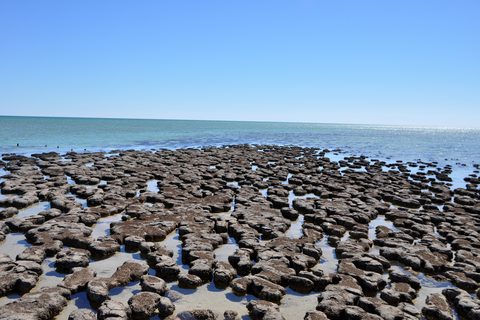
Photograph: Halooch, History - panoramio - Halooch, CC BY 3.0, cropped
Photograph: Phil Whitehouse, Hamelin Pool (Stromatolites), CC BY 2.0
Photograph: Summerpuss, CC BY-SA 4.0, cropped
Photograph: Calistemon, CC BY-SA 4.0, cropped
Photograph: Donald Hobern, Hamelin Pool, CC BY 2.0, cropped
Photograph: Calistemon, CC BY-SA 4.0, cropped




