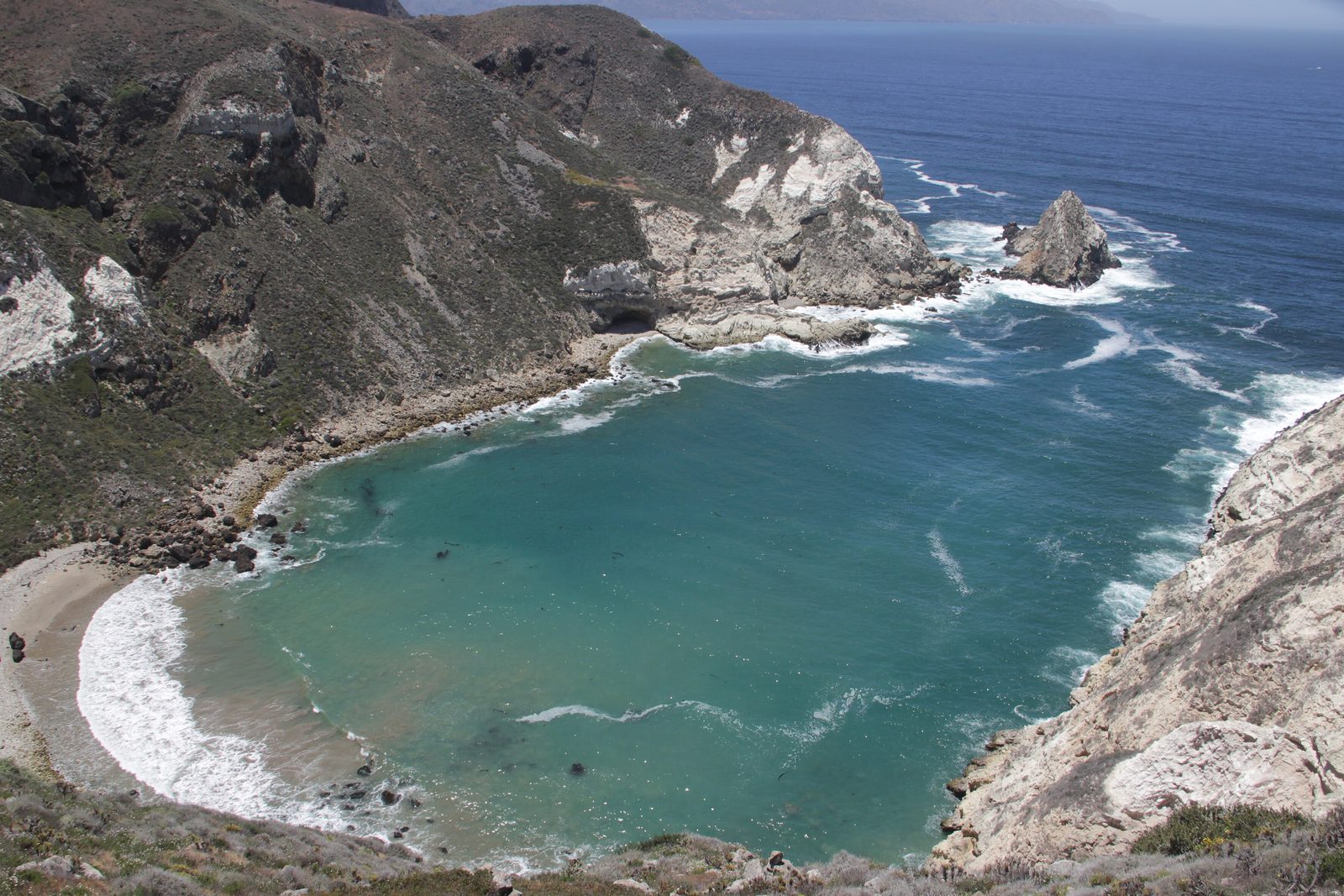
The short answer
Channel Islands National Park is made up of five of the eight Channel Islands, which span 160 miles off the coast of southern California: San Miguel, Santa Rosa, Santa Cruz, Anacapa and Santa Barbara, with the submerged lands and waters within one nautical mile of each. Anacapa and Santa Barbara were made a national monument in 1938; Congress established the national park on 5 March 1980, the National Park Service says. The mainland visitor centers are in Ventura and Santa Barbara; the islands themselves are reached only by the park’s concession boats, run by Island Packers, or by private boat. Anacapa, the nearest, has its own page in this library.
From Tally’s diary
A long stretch of open sea, dolphins racing the bow, then a dry gold island with an old stone ranch house and nobody selling anything at all. A small grey-and-rust fox, no bigger than a cat, trotted past my lunch as if late for a meeting and did not look back. I said good afternoon to its tail. Far off, the mainland lay along the horizon in a brown haze.
The Park Service’s description of the park turns on isolation: over thousands of years it has created animals, plants and archaeological resources found nowhere else on Earth, and kept a place where visitors can see coastal southern California as it once was. Santa Cruz, at more than 96 square miles the largest island in California, has eight plant species and a bird, the island scrub-jay, found on no other island; Santa Rosa, the second largest, has six plant species of its own.
Why it's worth knowing
A fox brought back from fifteen. The island fox is one-third smaller than its gray fox ancestor, 12 to 13 inches tall and 4 to 5 pounds, the Park Service says, and each island’s foxes are a separate subspecies: San Miguel’s have shorter tails, with one fewer tail bone, and longer noses. With no natural predators they hunt by day as well as at night. In the 1990s four subspecies crashed; on the park’s islands the cause was golden eagles, which had settled as resident breeders, feeding on the islands’ feral pigs and other introduced animals, once DDT had removed the bald eagles that kept them out. The recovery programme began in 1999. The park’s three subspecies were federally listed as endangered in 2004; the last captive foxes went back to the wild in 2008, and the Park Service says the population has recovered within the park and that the IUCN Red List now lists the island fox as near threatened.
Islands older than their names. During the last ice age, with the sea about 350 feet lower, the four northern islands were one island that researchers call Santarosae, and pygmy mammoths, four to six feet tall, lived on it; the most complete skeleton yet found was dug up on Santa Rosa in 1994. The Park Service’s timeline dates human occupation at Arlington Springs on Santa Rosa to about 12,900 years ago and says the oldest known human remains in North America date to it. The Chumash lived on the islands for thousands of years: Santa Cruz, which they call Limuw, “in the sea”, had ten villages housing over 1,200 people, made shell-bead money traded across California, and crossed to the mainland in tomols, frameless plank canoes. The last Island Chumash moved to the mainland in the 1820s, after the missions and a measles epidemic in 1806. In 2001 members of the Chumash community paddled a tomol across the channel to Limuw, the first to travel the historic route since the 1870s.
The field notes
A miniature California
The Park Service calls Santa Cruz Island a miniature California: two rugged mountain ranges with the highest peaks on the islands, above 2,000 feet, a central valley along a fault, canyons with year-round springs and streams, and 77 miles of coastline with sea caves, tide pools and beaches. It supports more than 600 plant species, 140 land bird and 11 land mammal species. The Nature Conservancy owns and manages the western 76 per cent; the Park Service owns the eastern 24 per cent, where boats land at Scorpion Anchorage and an 1883 masonry ranch house is now the Scorpion Ranch Visitor Center. A legend the Park Service repeats says the island was named for a priest’s staff left there during the Portolá expedition of 1769 and returned by a Chumash man.
Santa Rosa and its pines
In the spring of 2026 a wildfire burned nearly 40 per cent of Santa Rosa Island. The island is also home to the Santa Rosa Island Torrey pine, a subspecies the Park Service calls one of the rarest pines in the world, the last members of a once widespread ice-age forest. Its only other population, a separate subspecies, grows on the mainland near La Jolla.
Eagles, pelicans, murres
The fox was not the only return. The Park Service’s timeline records bald eagles released into the park in 2002 and the first chicks in over 50 years hatching in 2006; the first peregrine falcon chicks in over 50 years on Santa Barbara Island in 2007; and California common murre chicks hatching in 2011 for the first time since 1912. In 1970, it says, pesticide contamination left a single California brown pelican chick surviving on Anacapa, then the main US nesting site.

December 2023An island fox, found only on the Channel Islands.
Photograph: cricketsblog, Island fox - 53427554494, CC BY 2.0

December 2023An island scrub-jay, a bird found only on Santa Cruz Island.
Photograph: cricketsblog, Island scrub-jay, CC BY 2.0

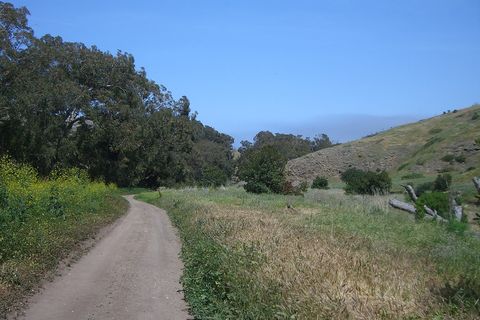
May 2009The dirt road up Scorpion Valley, inland from the Scorpion landing on Santa Cruz Island.
Photograph: NPS, Public domain, cropped
- Pack the day as if the shop has shut. There is no shop.
- Close your bag every time you put it down. The foxes are small, quick and very interested in lunch.
- These islands were somebody’s home long before they were a park, and their old places still are. Leave every shell and stone where it lies.
- Sit on the bluff above the landing and watch the water for a long while. Something usually comes up to see who is watching.
- Hold the list tightly on the crossing. (Held it tightly. The spray read it first and made several corrections, mostly to my spelling.)
A relic from the Channel Islands
Relic, entry 323Width: 100 feetEntrance ceiling: 160 feet
Painted Cave. On the northwest coast of Santa Cruz Island, the National Park Service says, is one of the largest and deepest sea caves in the world: nearly a quarter of a mile long and 100 feet wide, with an entrance ceiling 160 feet high and, in spring, a waterfall pouring over the entrance. It takes its name from its colours, which no one painted: the Park Service puts them down to the cave’s own varied rock, its lichens and its algae. The cave opens on the sea, on the far side of the island from the landing at Scorpion Anchorage, and it is seen from the water.
Tally, in the marginI had taken the name at its word and spent some while wondering who had got up there with a brush, and how. It was the rock and the weed and the lichen, doing it themselves, slowly, with nobody watching. I have rarely felt so outdone by a wall.
Getting there
- 1
Reaching the mainland visitor centers
The mainland visitor centers in Ventura and Santa Barbara can be reached by car, bicycle or public transport; the Park Service names Los Angeles International, Burbank and Santa Barbara airports, and the Amtrak stations at Ventura and Oxnard.
- 2
The concession boat
Island Packers, the park’s concessioner, sails all year from Ventura Harbor and Channel Islands Harbor in Oxnard, and runs non-landing wildlife trips too; private boaters can also land.
- 3
Crossing to Santa Rosa
Santa Rosa Island lies 40 nautical miles from the Ventura visitor center, and day trips there give about three to four hours ashore.
- 4
On the islands
There is no transport on the islands, and bicycles are not allowed: everything is reached on foot or by boat.
- ✓
| J | F | M | A | M | J | J | A | S | O | N | D |
|---|---|---|---|---|---|---|---|---|---|---|---|
| January: best time | February: best time | March: best time | April: also a good time | December: also a good time |
- The yellow coreopsis peaks from late January through March
- Gray whales pass from late December to April
How to get there. By boat. No entrance pass is needed for the park.
When to go. Any time of year, but the seasons differ, the Park Service says. In a normal year the islands turn green and the yellow coreopsis peaks from late January through March, and island fox pups are born in spring. Most people visit from June to August. Fall is the season many consider best for snorkelling, diving and kayaking, with water up to about 70°F and visibility up to 100 feet. Gray whales pass from late December to April, and blue and humpback whales from spring through summer.
What to arrange ahead. A seat on the boat, and camping reservations for an overnight stay. The Park Service says there are no services such as food stores or gear rental on the islands, so visitors bring all their food and gear and, on most islands, their water.
Safety. The hazards are the islands’ own: sun and wind with little shade, cliffs, cold water and the swell at the landings. In an emergency, dial 911.
Mark this place
The passport stamp for this place.
Common questions
Where is Channel Islands National Park?
Channel Islands National Park is five of the eight Channel Islands off the coast of southern California: San Miguel, Santa Rosa, Santa Cruz, Anacapa and Santa Barbara, with the waters within one nautical mile of each. Its mainland visitor centers are in Ventura and Santa Barbara, the National Park Service says.
How do you get to Channel Islands National Park?
By boat. The National Park Service says the islands of Channel Islands National Park are reached only by the concession boats of Island Packers, sailing from Ventura Harbor and Channel Islands Harbor in Oxnard, or by private boat. There is no transport on the islands, and bicycles are not allowed.
Is there an entrance fee for Channel Islands National Park?
No. Channel Islands National Park, off southern California, needs no entrance pass; visitors pay for the boat crossing with Island Packers and for campsites, which are booked separately.
What is the island fox?
The island fox is a small fox, 12 to 13 inches tall and 4 to 5 pounds, that lives on six of the eight Channel Islands off southern California and nowhere else on Earth, the National Park Service says. Each island has its own subspecies, and three of them live in Channel Islands National Park, on San Miguel, Santa Rosa and Santa Cruz.
How did the island fox recover?
Golden eagles cut the island fox to 15 animals on San Miguel and 15 on Santa Rosa by 2000, with fewer than 80 on Santa Cruz. From 1999 Channel Islands National Park bred foxes in captivity, moved golden eagles away, brought back bald eagles and removed sheep and pigs; the last captive foxes were released in 2008, the National Park Service says.
What is Painted Cave?
Painted Cave, on the northwest coast of Santa Cruz Island in Channel Islands National Park, is one of the largest and deepest sea caves in the world, the National Park Service says: nearly a quarter mile long and 100 feet wide, with an entrance ceiling of 160 feet. It is named for its colourful rock, lichens and algae.
Who lived on the Channel Islands before the park?
The Chumash lived on the northern Channel Islands for thousands of years. Santa Cruz Island, which they call Limuw, had ten villages housing over 1,200 people, the National Park Service says. The last Island Chumash moved to the mainland in the 1820s, and in 2001 a Chumash crew paddled a tomol, a plank canoe, back across to Limuw.
When is the best time to visit Channel Islands National Park?
The National Park Service says Channel Islands National Park can be visited all year. In a normal year the coreopsis flowers peak from late January through March; gray whales pass from late December to April; and many consider fall the best season for snorkelling and diving, with water up to about 70°F and visibility up to 100 feet.
Photographs on this page
Tap a photograph to see it full size.
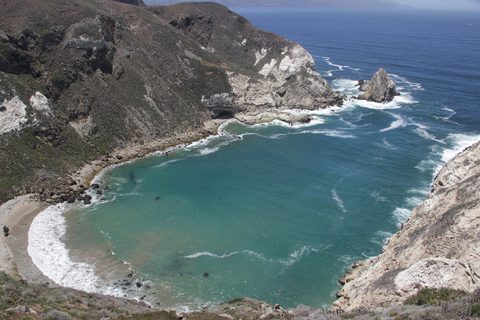
Photograph: Björn S..., Potato Harbor, CC BY-SA 2.0, cropped
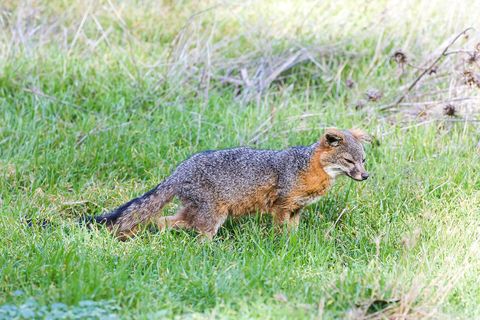
Photograph: cricketsblog, Island fox - 53427554494, CC BY 2.0
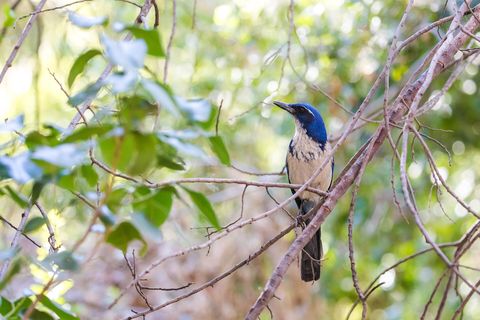
Photograph: cricketsblog, Island scrub-jay, CC BY 2.0
Photograph: NPS, Public domain, cropped




