The short answer
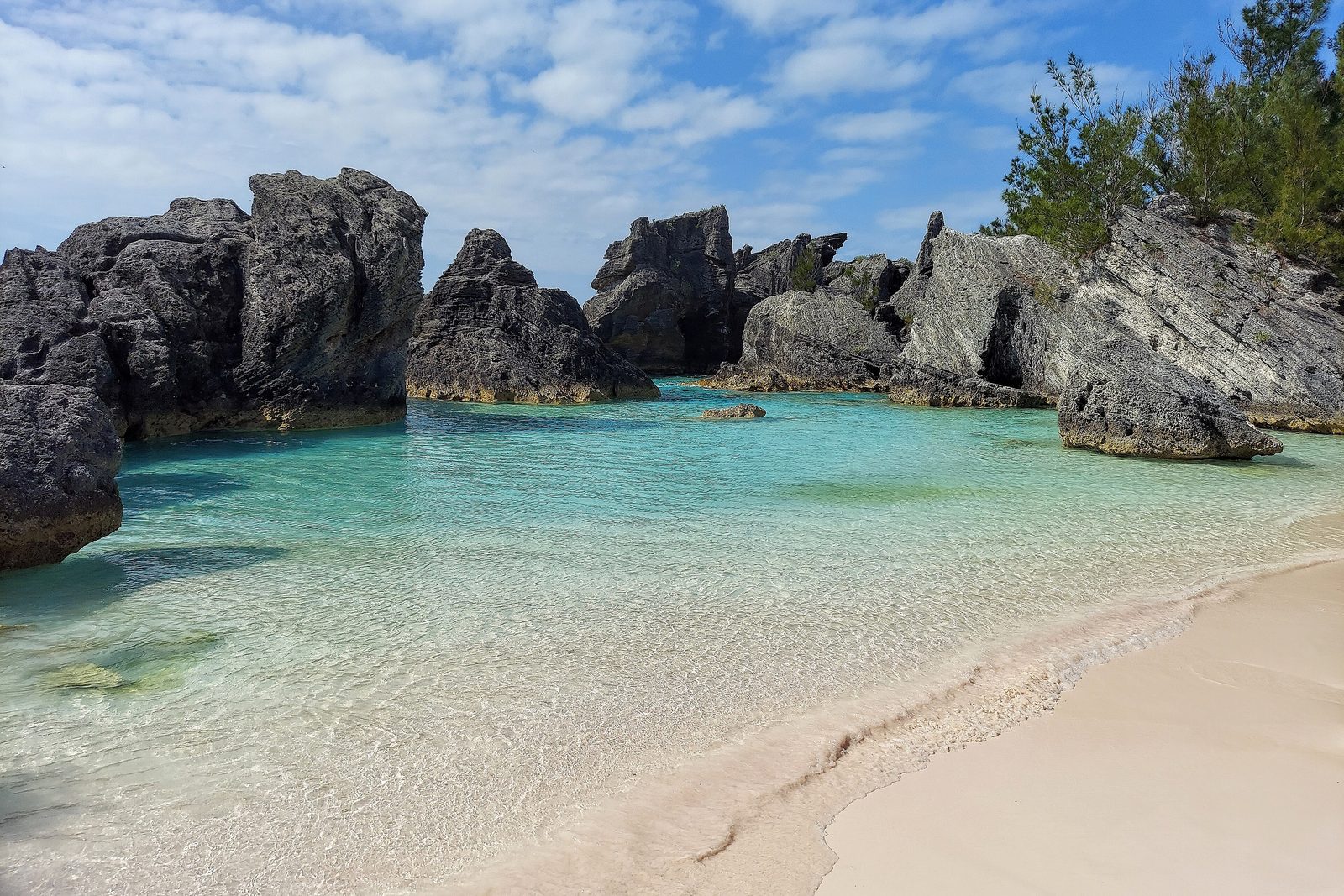
Bermuda is a British Overseas Territory in the North Atlantic Ocean, Wikipedia records, with a land area of 54 square kilometres and around 64,000 people in 2019. It consists of over 150 limestone islands, five of them main islands, on the limestone cap of a seamount; the closest land outside the territory is in the US state of North Carolina, about 1,035 kilometres to the west-northwest. The Spanish explorer Juan de Bermúdez found the islands in the early 1500s, and they are named after him. The capital is Hamilton. Finance is now the largest part of the economy; tourism, the second largest, brought more than half a million visitors a year, more than 80 per cent of them from the United States.
From Tally’s diary
Pastel houses on every hill with roofs as white as iced cakes, all of them stepped like little staircases, and the water round them a blue I associated with paintboxes. The beach had a pink flush to it that no amount of staring would explain. I rode a bus along a road with stone walls close on both sides, and the driver greeted everybody who climbed aboard, me included.
Why it's worth knowing
Rain on the roof. With no rivers or freshwater lakes, Bermuda’s fresh water is the rain, collected on roofs and catchments, or drawn from underground lenses, and stored in tanks; most dwellings have at least one tank as part of their foundation, and the law requires each household to collect the rainwater piped down from its roof, Wikipedia records. Rainfall is highest in October, at over 150 millimetres, and lowest in April and May.

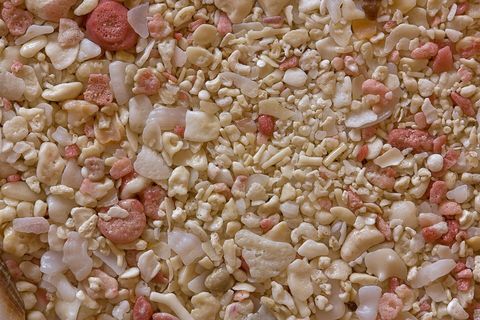
October 2012Bermuda beach sand, 32 mm across: the red grains are Homotrema rubrum.
Photograph: Siim Sepp (Sandatlas), 00290 IMG 6291 037 Bermuda coral sand 32 mm, CC BY-SA 3.0
Pink sand. Homotrema rubrum is a bright red foraminifer, a single-celled organism that grows on coral rubble on the reef crest; ground by the surf into sand-sized pieces, it is what gives Bermuda’s beaches their pink tint, Wikipedia records. Horseshoe Bay and Warwick Long Bay are among the beaches the island’s article names.
A wreck and a play. In 1609 a fleet of seven ships carrying settlers and supplies to Jamestown was broken up by a storm, and its flagship, the Sea Venture, was driven onto Bermuda’s reef to keep her from sinking, Wikipedia records. About 150 survivors were stranded for some nine months and built two ships, the Deliverance and the Patience, to carry them on to Virginia; three men stayed behind to hold the islands for the Virginia Company. Wikipedia’s article on the ship says the wreck “is widely thought to have been the inspiration” for Shakespeare’s The Tempest of 1611.
The field notes
The old town by the harbour
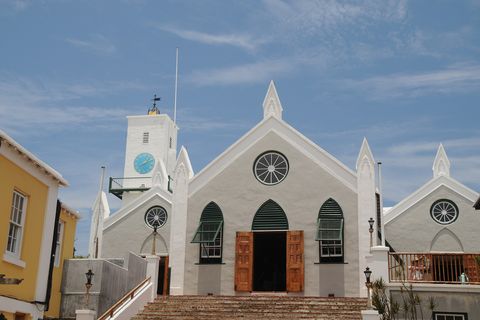
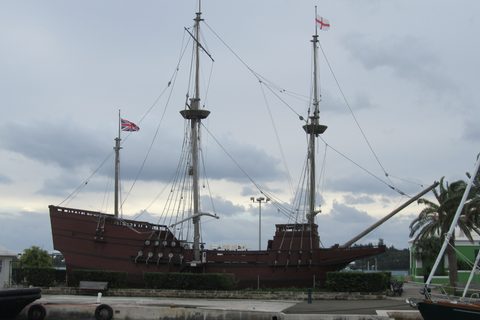
St. George’s, first called New London, was settled in 1612 and was Bermuda’s capital until 1815, Wikipedia records. Its State House of 1620 was the first stone building in Bermuda other than its forts, and is the oldest building on the island; St. Peter’s Church is described as the oldest surviving Anglican church in the Western Hemisphere. In King’s Square, excavations by Bristol University and the Bermuda National Trust found the foundations of the governor’s house of 1612. On Ordnance Island in the harbour stand a replica of the Deliverance and a statue of Sir George Somers by Desmond Fountain. In 1775, at George Washington’s request, Bermudians helped the American rebels carry gunpowder from a magazine in the town over the hill to Tobacco Bay. The town and its fortifications became a World Heritage site in 2000.

November 2013The replica of the Deliverance on Ordnance Island, St. George's.
Photograph: Anne and David of Kent, England, Public domain, cropped
Slavery came to Bermuda in the colony’s first years: the first two enslaved people, one Black and one Native American, were brought from the West Indies in 1616 to dive for pearls, and Africans and Native Americans were held there after them, Wikipedia records; its history of the islands notes that The History of Mary Prince, a Bermudian woman’s slave narrative published in 1831, helped the abolitionist cause toward emancipation throughout the British Empire in 1834.
Caves, a lighthouse and a very small bridge
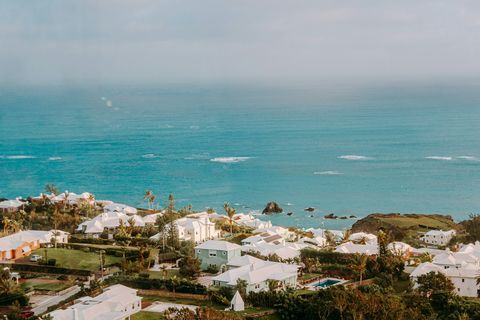
The Royal Naval Dockyard, home of the National Museum of Bermuda, is the most popular visitor attraction, Wikipedia records; others include the Crystal Caves, with stalactites and underground saltwater pools, the Gibbs Hill Lighthouse and the Botanical Gardens. Somerset Bridge, which Wikipedia calls the world’s smallest drawbridge, opens a gap of 32 inches. Nearly 80 per cent of visitors arrive by cruise ship, about 535,000 in 2024, against about 140,000 by air; the air visitors spent 78 per cent of the money.

White limestone roofs below Gibb's Hill Lighthouse, 2020.
Photograph: Sandra Seitamaa via Unsplash, Unsplash licence

June 2009St Peter's Church in St George's.
Photograph: David Broad, Bermuda - St George's - St. Peter's Church - panoramio, CC BY 3.0, cropped

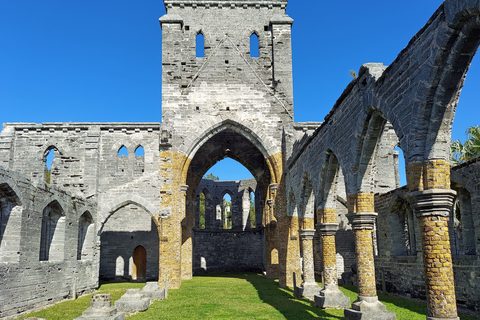
March 2023The Unfinished Church in St. George's.
Photograph: P. Hughes, CC BY-SA 4.0, cropped
- Greet the bus driver as you climb aboard, and mean it. Then take a window seat.
- Find out where the pink comes from. (The list lay on the sand for a moment and came back with a blush along its edge that has not faded. I am choosing to believe it was flattered.)
- Climb up to the lighthouse on the hill and look at the whole place spread out below, roofs and coves and pale shapes under the water.
- The lanes and gardens belong to the people who live along them. Keep to the road, admire the gardens over the wall, and leave the gates as you found them.
- Stand in the old town’s square by the harbour as the light goes, and imagine arriving here by accident.
A relic from Bermuda

Relic, entry 280Organism: Homotrema rubrumGrows on coral rubble on the reef crest
A pinch of pink sand. The pink on Bermuda’s beaches comes from Homotrema rubrum, a bright red single-celled sea creature that grows on coral rubble on the reef crest and is broken into sand-sized pieces by the surf. The colour is in the grains themselves, and the beaches keep them.
Tally, in the marginI took the pink for a trick of the light, and waited most of the afternoon for it to wear off. It stayed. Close up, on my paw, it turned into a few red crumbs among a great many white ones, each minding its own business, and between them making a whole beach blush.
Getting there
- 1
By air or by cruise ship
By air to L.F. Wade International Airport, formerly Kindley Field, where regular commercial flights began in 1948; or by cruise ship.
- 2
Getting about without a car
Non-residents have traditionally been barred from driving cars, and visitors get about by the government’s buses and ferries, by taxi, or on rented scooters and, more recently, small cars.
- ✓
When to go. Bermuda lies on the boundary between a humid subtropical and a tropical rainforest climate, Wikipedia records, and October is the wettest month. The Atlantic hurricane season runs from early June to the end of November, and the ferries stop in rough weather.
What to arrange ahead. One pass covers both buses and ferries, for a day or for several days running, and cash fares are exact change only.
Safety. Bermuda’s roads are narrow, winding and often without shoulders, and accidents, particularly on motorcycles, are frequent.
Mark this place
The passport stamp for this place.
Common questions
Is Bermuda in the Caribbean?
No. Bermuda is a British Overseas Territory in the North Atlantic Ocean; the nearest land outside it is in North Carolina, about 1,035 kilometres to the west-northwest, Wikipedia records.
Why is Bermuda's sand pink?
Bermuda’s beaches are tinted pink by Homotrema rubrum, a bright red single-celled foraminifer that grows on coral rubble on the reef and is ground into sand-sized pieces by the surf, Wikipedia records.
Where does Bermuda get its fresh water?
Bermuda has no rivers or freshwater lakes, so its fresh water is rain collected on roofs and catchments and stored in tanks, or drawn from underground lenses; the law requires each household to collect the rainwater from its roof, Wikipedia records.
Can tourists drive a car in Bermuda?
Non-residents have traditionally been barred from driving cars in Bermuda, Wikipedia records; visitors use the government’s buses and ferries, taxis, or rented scooters and, more recently, small cars.
What was the Sea Venture?
The Sea Venture was the flagship of a 1609 fleet bound for Jamestown, driven onto Bermuda’s reef in a storm; its survivors spent about nine months on the islands. Wikipedia’s article on the ship says the wreck is widely thought to have inspired Shakespeare’s The Tempest (1611).
What is St. George's, Bermuda?
St. George’s, settled in 1612, is the first permanent English settlement in Bermuda and was its capital until 1815, Wikipedia records. With its fortifications it has been a UNESCO World Heritage site since 2000; its State House of 1620 is the oldest building on the island.
Can you use one pass on Bermuda’s buses and ferries?
Yes. Bermuda’s government sells passes valid on both its buses and its ferries, for a day or for several consecutive days.
When is hurricane season in Bermuda?
From early June to the end of November, the Atlantic hurricane season. Bermuda’s wettest month is October.
Photographs on this page
Tap a photograph to see it full size.
Photograph: P. Hughes, CC BY-SA 4.0, cropped
Photograph: Siim Sepp (Sandatlas), 00290 IMG 6291 037 Bermuda coral sand 32 mm, CC BY-SA 3.0
Photograph: David Broad, Bermuda - St George's - St. Peter's Church - panoramio, CC BY 3.0, cropped
Photograph: Sandra Seitamaa via Unsplash, Unsplash licence
Photograph: Anne and David of Kent, England, Public domain, cropped
Photograph: P. Hughes, CC BY-SA 4.0, cropped




